
Out Bound Dialer Guide for CXOs Strategies and ROI
The strongest number in outbound calling isn't dials per rep. It's the gap between volume and conversation quality. The global outbound dialer systems market was valued at $2.5 billion in 2025 and is projected to reach $3.2 billion by 2031 at a 9.4% CAGR, driven by AI predictive dialers in sectors such as BFSI and EdTech, according to outbound dialer systems market reporting. For CXOs, that matters because the market isn't expanding just because firms want more calls. It's expanding because manual calling can't sustain modern outreach economics, compliance obligations, or customer expectations.
Most sales and service leaders already know the operational symptoms. Teams spend too much time waiting through ring cycles, bad numbers, voicemail drops, and patchy hand-offs. Connect rates are under pressure. Compliance exposure sits with operations, legal, and revenue leadership at the same time. A manual workflow might still function at small scale, but it becomes expensive friction once a business needs consistent follow-up across property enquiries, KYC reminders, programme counselling, renewals, or presales scheduling.
An out bound dialer changes that operating model. It automates call initiation, routes live conversations, applies pacing logic, and increasingly adds AI-led qualification before a human agent gets involved. The strategic question isn't whether to automate. It's which architecture, control model, and performance metrics create ROI without creating regulatory or brand risk.
Table of Contents
- Introduction to Out Bound Dialer for Business Growth
- Understanding the Out Bound Dialer Core Concepts
- Exploring Out Bound Dialer Architectures
- Identifying Key Metrics and Compliance for Out Bound Dialer
- Real World Use Cases and ROI of Out Bound Dialer
- Implementation Checklist and Integration for Out Bound Dialer
- Best Practices for Scaling and Measuring Out Bound Dialer
- Conclusion and Next Steps for Out Bound Dialer Strategy
Introduction to Out Bound Dialer for Business Growth
Executives usually buy an out bound dialer for efficiency. The better reason is control. A dialer gives the business tighter control over agent capacity, call routing, data use, timing rules, and follow-up discipline. That's what turns outbound from an unpredictable activity into a managed revenue and service engine.
In practical terms, the use cases cut across sectors. An EdTech admissions team can qualify inbound form fills before a counsellor takes over. A BFSI operations unit can handle service reminders and KYC nudges with clearer routing. A real estate sales desk can respond to project enquiries while interest is still high. An e-commerce retention team can recover at-risk customers through structured outbound conversations rather than waiting for support tickets.
What has changed is the role of AI inside the stack. Older dialers mainly solved the mechanics of calling. Newer systems can also shape pacing, identify whether a call is worth escalating, and standardise qualification logic before a human joins. That shift matters because many organisations have already optimised basic activity. Their next gain won't come from forcing more dials. It will come from improving who gets connected, what happens during the call, and how consistently the workflow stays compliant.
Practical rule: If leadership reviews only dial volume, they're measuring labour effort. If leadership reviews connection quality, qualification quality, and compliance status together, they're measuring operating performance.
Understanding the Out Bound Dialer Core Concepts
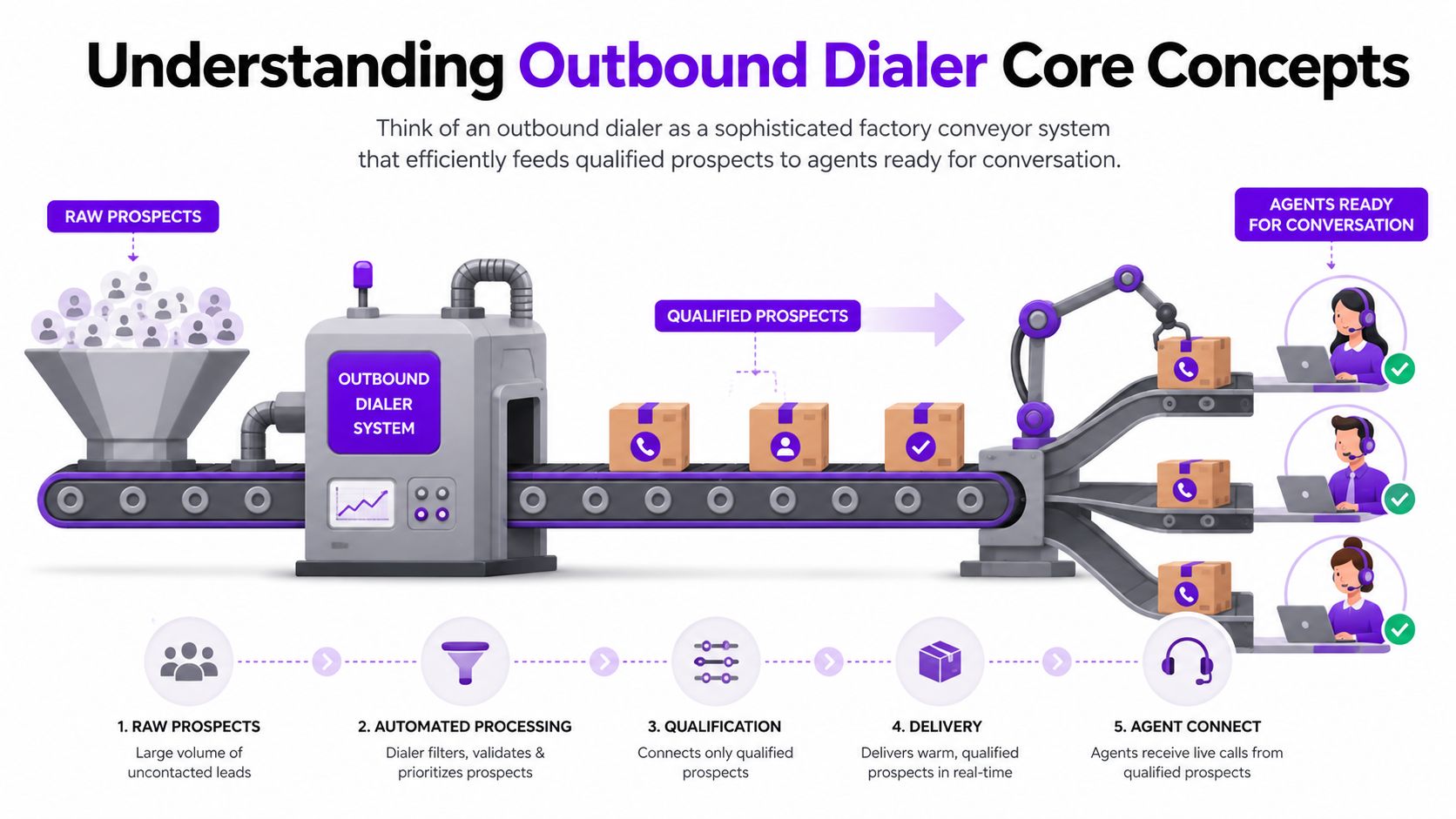
An out bound dialer is a workflow engine for conversations. It decides which record should be called, when the call should happen, which agent or voice workflow should handle it, and how the result should be written back into the system of record.
Why the dialer matters beyond speed
That distinction matters because outbound performance is usually misread. Many teams still judge success by dials per hour. That metric captures activity, but it misses whether the system is creating compliant, useful conversations or increasing contact attempts.
Manual calling blends low-value tasks with high-value work. A rep checks the CRM, verifies the record, dials, waits through ring time, tags the outcome, and schedules the next step. A dialer separates those steps and automates the repetitive parts. The gain is not just speed. It is consistency in timing rules, list handling, callback discipline, and agent utilisation.
The hidden cost sits in the gaps between those actions. Lead ageing increases while records wait. Follow-up windows slip. Logging quality drops under time pressure. Compliance risk rises when call timing, consent status, or disposition rules depend on individual agent habits rather than system logic.
This is also where AI voice agents change the economics. Legacy dialers improved call volume. AI-enabled outbound programs can screen intent, handle basic qualification, collect structured responses, and pass only qualified or sensitive conversations to human agents. That shifts the management question from "How many calls did we place?" to "Which conversations required skilled human time, and which could be resolved earlier in the workflow?" Teams comparing options often start with dial speed, then realise the bigger decision is how much of the conversation stack should be automated. A practical reference point is this guide to auto dialer software and calling workflows.
The main dialer types in plain business terms
Different dialers exist because outreach programs optimise for different constraints. Some protect conversation quality. Others maximise agent occupancy. The right choice depends on call value, list quality, answer rates, and the cost of getting compliance wrong.
| Dialer type | Best fit | Trade-off |
|---|---|---|
| Preview dialer | High-value or consultative calls | Slower pace, stronger personalisation |
| Progressive dialer | Structured follow-up teams | More control, less raw throughput |
| Power dialer | Reps who need fast one-by-one execution | Efficient, but still agent-led |
| Predictive dialer | Large teams optimising live connection flow | Higher complexity and tighter compliance oversight |
A preview dialer gives the agent record context before the call starts. That makes sense when the financial or relationship value of each conversation is high. Lending, high-ticket B2B sales, wealth products, and premium real estate fit this model because a poor call is more expensive than a slower one.
A progressive dialer places one call per available agent in a controlled sequence. It fits renewals, reminders, and structured follow-up programs where pacing matters but over-dialing creates operational or regulatory problems. For many teams, this is the cleanest midpoint between control and throughput.
A power dialer removes manual dialing and moves the rep quickly from one record to the next. It is useful for SDR teams, inside sales, and retention programs that still rely on human-led conversations but need less idle time between attempts.
A predictive dialer uses pacing logic to call ahead of agent availability and connect live answers as soon as possible. It can produce the highest throughput, but it also creates the sharpest trade-offs. Abandoned calls, silent pauses, and poor list governance can turn an efficiency gain into a compliance cost. That cost is often omitted from ROI models, especially when procurement focuses on licence price and headline productivity.
The strategic question is not which dialer is most advanced. It is which model aligns labour cost, conversation value, and compliance exposure.
AI adds another layer to that decision. In a preview or progressive setup, AI can summarise account history, recommend next actions, or run the first qualification step before a person joins. In power and predictive environments, AI can score outcomes, detect call intent, and divert low-value interactions away from agents. The non-obvious ROI opportunity is that better conversation filtering can raise conversion efficiency without raising dial volume. For executive teams, that is a stronger operating improvement than activity growth alone.
Exploring Out Bound Dialer Architectures
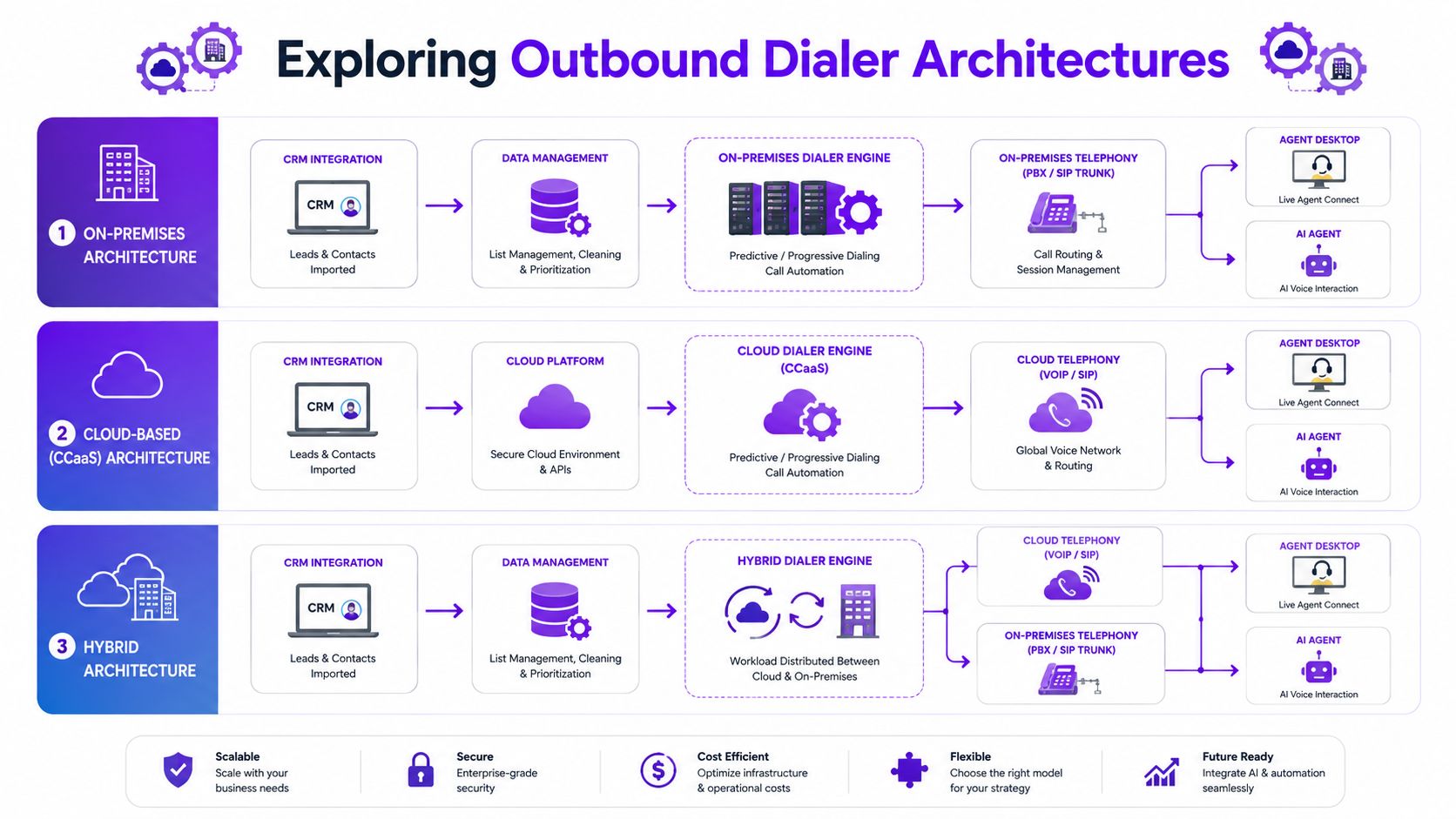
Architecture decisions shape cost, control, and deployment speed more than most procurement teams expect. The core choice isn't software versus software. It's whether your organisation wants the dialer to behave like infrastructure, like a service, or like a mixed operating layer.
Three operating models executives actually choose between
An on-premises architecture gives the business tighter control over telephony, data handling, and custom workflows. Firms in regulated environments sometimes prefer this model when they already run internal telephony stacks and want direct oversight over integrations, routing rules, and access policies. The trade-off is heavier maintenance and slower change management.
A cloud CCaaS architecture shifts the centre of gravity. CRM, dialer logic, reporting, and agent interfaces are delivered through a cloud platform. This typically suits organisations that need faster rollout across multiple teams or locations, especially when central IT wants standardisation rather than bespoke local environments.
A hybrid model usually appears when a company has existing systems it can't retire but still wants AI and cloud-based orchestration on top. That's common in enterprises with older PBX investments, region-specific routing needs, or gradual migration plans.
A concise way to evaluate them is this:
- Choose on-premises when governance and internal control override agility.
- Choose cloud CCaaS when scale, speed, and easier administration matter most.
- Choose hybrid when the business needs innovation without a full rebuild.
For teams comparing feature depth across deployment models, the DialNexa auto dialer software overview is one example of how cloud-oriented outbound tooling is being positioned around callback speed and lead coverage.
Where AI voice agents sit in the call flow
The key architectural shift is that AI voice agents don't have to sit only at the reporting layer. They can sit inside the call path. That means the system can receive a campaign list from the CRM, launch calls through the dialer engine, let an AI agent handle first-line qualification, and then route only suitable calls to humans.
That model changes workforce design. Instead of every lead consuming agent time equally, the organisation can reserve human capacity for high-value or high-complexity interactions. In EdTech, that may mean an AI agent confirms programme interest before passing the lead to a counsellor. In real estate, it may mean collecting locality, budget, and timeline before a site-visit specialist steps in. In BFSI support, it may mean routing service and transactional intents differently.
A visual walkthrough helps clarify that call path:
The strategic point is simple. Once AI enters the live flow, architecture isn't only about uptime and integration. It becomes a design choice about who talks first, who qualifies, and when a human should enter the interaction.
Identifying Key Metrics and Compliance for Out Bound Dialer
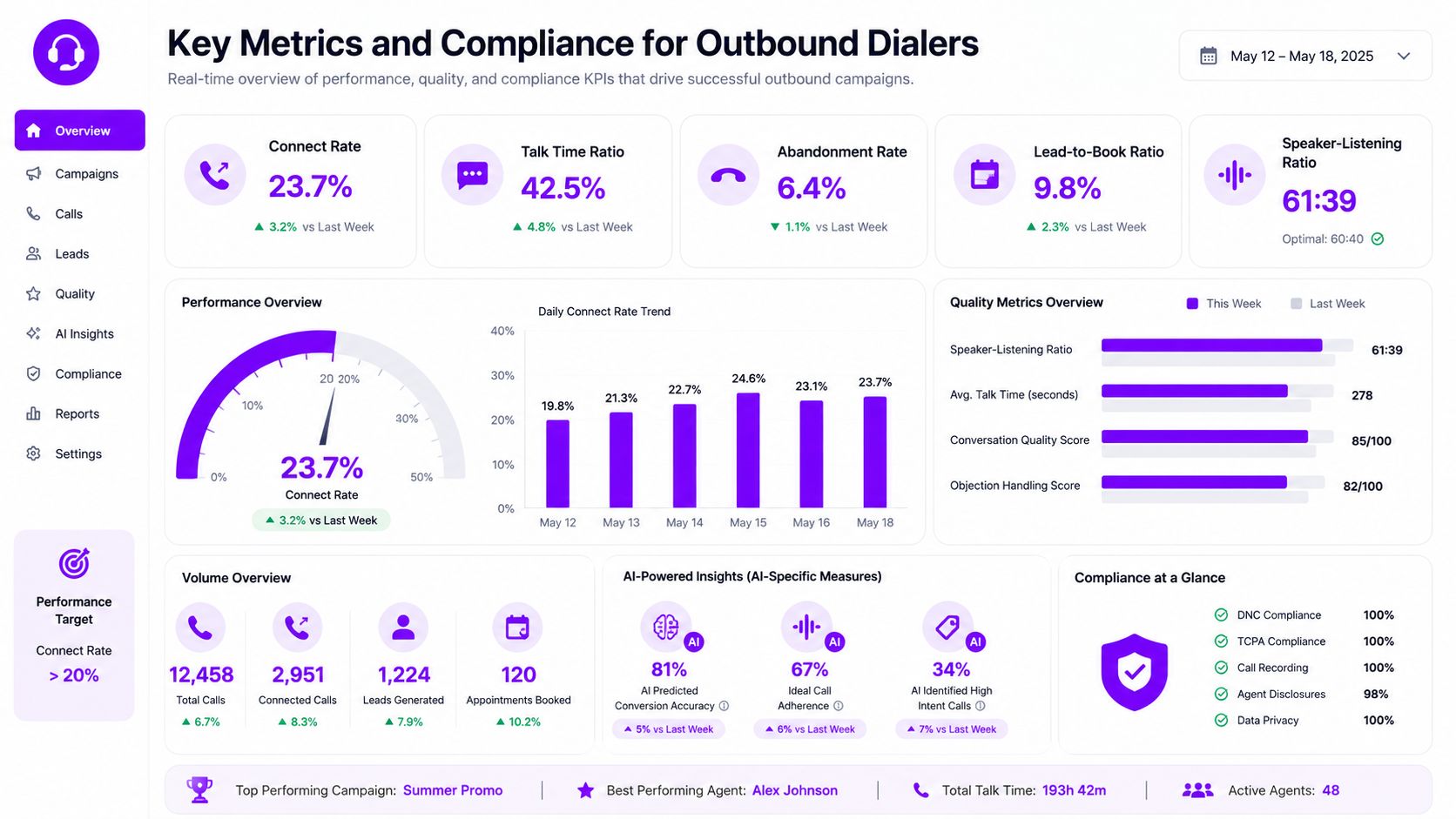
An out bound dialer should be judged like an operating system, not a calling gadget. The right scorecard combines throughput, conversation quality, and legal control.
The metrics that deserve board attention
The baseline productivity case is strong. Outbound dialers can increase agent productivity by up to 300% compared with manual dialling by filtering voicemail, busy signals, and similar dead-end events, according to this outbound dialer analysis from REVE Systems. That figure explains why operations teams adopt dialers quickly. It doesn't explain whether the business is creating better conversations.
Executives should separate five metric families:
| Metric family | What it tells leadership |
|---|---|
| Connect rate | Whether numbers, timing, and caller identity are working |
| Talk time ratio | Whether agents spend time in real conversations or in dead airtime |
| Abandonment rate | Whether pacing is aggressive enough to create compliance and customer risk |
| Lead-to-book ratio | Whether conversations convert into business outcomes |
| Conversation quality | Whether the interaction creates trust, information, and next-step clarity |
That final category is where many dashboards stay weak. A team can report strong dial velocity and still produce poor discovery. That's why leaders should add qualitative review and conversation-structure metrics to the same governance pack used for operational KPIs. A useful benchmark framework for contact teams appears in this contact centre KPI guide, especially when leadership needs a common language across sales and service functions.
The compliance controls that change ROI
In India, compliance is not an administrative afterthought. It directly affects campaign reach, number health, and legal exposure.
Commercial outbound calls to consumers must originate from a 160-series number, while promotional outbound calls require 140-series numbers, as outlined in this explainer on Indian voice calling requirements. If the wrong numbering format is used, calls can be flagged and blocked. That turns a telephony configuration error into a revenue problem.
The legal operating window is also strict. Outbound commercial and telemarketing calls are permitted only between 9:00 AM and 9:00 PM IST, and under the 2025 amendment to TCCCPR, senders using auto-dialer or robo-call technology must notify their telecom operator in advance with written notice covering the use case, expected daily call volume, and communication category, according to this summary of TRAI auto-dialer compliance rules.
Then comes list governance. TRAI mandates scrubbing against the National Customer Preference Register, and penalties can reach Rs 10 lakh per violation for TCCCPR breaches. The same rule set also notes that five unique complaints against a single sender within ten days trigger automatic action, while three complaints against a specific number can lead to immediate service disconnection, based on this Indian outbound sales compliance guide.
Compliance spend looks expensive only until one campaign loses number access, generates complaints, or gets blocked before it reaches a buyer.
The hidden ROI insight is that compliance features aren't a drag on performance. In regulated outbound environments, they are part of performance.
Real World Use Cases and ROI of Out Bound Dialer
Speed to first contact has measurable revenue impact. NICE reports that predictive dialers using AI pacing can raise connection rates from 47% to 91% when call velocity is adjusted in real time, according to NICE guidance on outbound dialer optimisation. That matters because the ROI of an out bound dialer is rarely created by call volume alone. It is created when faster connection is paired with better qualification, cleaner routing, and fewer wasted agent minutes.
EdTech shows the pattern clearly. A counselling team handling inbound programme enquiries loses value every hour a prospect sits untouched. An out bound dialer improves response speed, but the larger gain comes from sorting intent earlier in the process. A structured AI-assisted call can confirm course interest, budget range, preferred timing, and location before a counsellor joins. That changes unit economics. Senior counsellors spend more time on applicants who are ready for the next step and less time on records that are unreachable, duplicate, or low fit.
BFSI uses the same infrastructure for a different reason. The goal is often less about persuasion and more about controlled, repeatable outreach for KYC reminders, onboarding support, payment follow-up, or service resolution. In those cases, dialer ROI comes from reducing variance. Standardised scripts, logged dispositions, and rule-based routing produce a more consistent customer experience and lower the cost of rework when customers need escalation.
Real estate is one of the clearest examples of timing shaping revenue. Indian buyers often submit multiple property enquiries within a short window, and the first credible caller often gets the site visit. Local presence dialling can improve answer rates by 28% to 35% and is associated with 2% to 8% gains in lead-to-booking conversion, according to this analysis of local presence dialling and compliance tools. For developers and brokers, that means the dialer affects more than contact rates. It influences trust at the first interaction, which then affects show-up rates, site visits, and pipeline quality.
E-commerce teams tend to see ROI in lower-cost service and retention motions. Post-purchase support, COD verification, abandoned cart recovery, and win-back campaigns all depend on consistent follow-up. A dialer helps by standardising retry logic, routing, and outcomes across large customer segments. The hidden financial gain is operational. Teams reduce manual variance, shorten handling time for routine contacts, and reserve human attention for exceptions or high-value accounts.
The stronger strategic shift is the move from measuring dials and connects to measuring conversation outcomes.
A traditional dialer metric stack rewards volume. An executive dashboard may show attempts per hour, connect rate, and agent occupancy while missing whether the call produced a qualified next action. AI voice agents change that frame because they extend automation from call placement into live qualification. The practical question becomes: did the system confirm intent, collect missing data, classify objections, and route the conversation correctly? That is a better predictor of revenue than raw connect volume.
Here, hidden compliance costs and ROI opportunities converge. A campaign that increases connects but triggers spam labeling, repeated-call complaints, or poor-quality transfers can raise cost per qualified opportunity even when top-line dial counts look strong. Number reputation management matters here. Using DialNexa's guidance on improving pickup rates through timing, routing, and structured voice workflows is useful when teams want to improve answer performance without relying on blunt increases in attempt volume.
The practical ROI model is broader than labour savings. It includes faster lead response, better agent utilisation, higher qualification accuracy, lower rework, and fewer losses from poor calling practices. Organisations that measure only calls placed will miss a large share of the value. Organisations that measure qualified next steps, compliance-safe contact rates, and downstream conversion will see where an out bound dialer produces margin.
Implementation Checklist and Integration for Out Bound Dialer
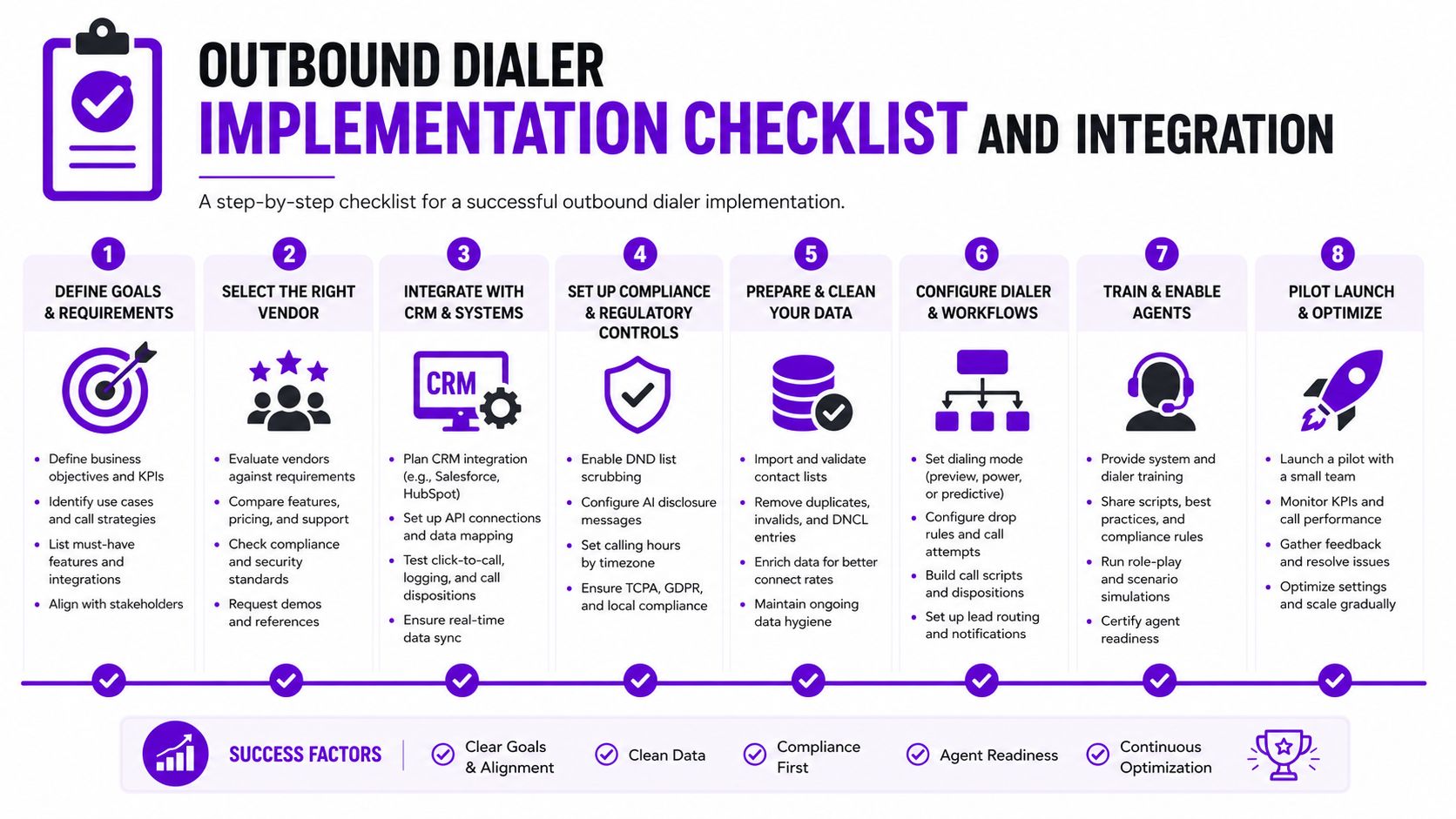
Implementation quality determines whether an out bound dialer improves revenue efficiency or only increases call activity. Teams that launch before aligning data ownership, routing logic, consent controls, and review workflows usually get a misleading early signal. The system appears productive because attempts rise, while transfer quality, compliance exposure, and downstream conversion remain unclear.
A practical rollout sequence
A disciplined rollout starts with operating design, not software configuration. The first decision is the business motion. Lead qualification, appointment booking, collections, renewals, and reactivation campaigns each require different pacing rules, scripts, escalation paths, and success metrics. A dialer configured for volume can perform poorly in workflows where conversation quality determines value.
The second decision is where the conversation changes hands. If an AI voice agent qualifies interest but transfers incomplete context to a human queue, handle time rises and customer trust falls. If the hand-off includes verified intent, captured fields, objection tags, and next-step reason codes, the dialer becomes part of a revenue workflow rather than a calling tool.
Use this rollout sequence:
- Define the commercial use case. Specify the outcome the dialer must produce, such as booked meetings, payment commitments, renewal saves, or verified lead qualification.
- Map every hand-off. Document where AI, agents, supervisors, and specialist teams take control, and what data must pass with the call.
- Audit input data before launch. Check number validity, duplicate records, segmentation rules, consent status, and disposition standards.
- Set system ownership. Decide whether the CRM or dialer is the source of truth for lead status, call outcomes, transcripts, and audit records.
- Limit the pilot scope. Test one workflow end to end so the team can isolate operational gaps and measure business impact clearly.
A broad pilot often obscures the underlying problem. One campaign can fail because of weak list quality, while another fails because transfers are poorly designed. Running both at once makes diagnosis slower and executive decisions weaker.
What to configure before the pilot starts
Compliance controls need to be configured before the first record is loaded. For India-based operations, that means building AI disclosure, DND scrubbing, permitted calling windows, and retention workflows into the system design from the start, as outlined in this guide to AI outbound calling compliance in India. These controls affect ROI directly. A campaign with higher connect rates can still produce worse economics if it increases complaint risk, creates audit gaps, or damages number reputation.
That creates five setup requirements:
- Consent workflow: Store the legal basis for contact at record level before a campaign goes live.
- DND scrubbing: Check suppression and preference status before each campaign launch, not only during list import.
- Calling window controls: Restrict call timing in the platform so manual overrides do not create avoidable risk.
- Disclosure scripting: Configure opening scripts to identify the company, the purpose of the call, and AI involvement when applicable.
- Retention and retrieval: Set policies for recordings, transcripts, consent logs, and audit access with legal, security, and operations teams.
Integration decisions deserve the same scrutiny as script design. If the dialer writes dispositions differently from the CRM, reporting fragments quickly. Marketing sees one funnel, sales sees another, and compliance teams struggle to reconstruct customer history. The cost is not only operational confusion. It also shows up in duplicated follow-up, weaker attribution, and longer resolution time during audits or customer disputes.
Vendor evaluation should therefore focus on integration fit. Check whether the platform supports APIs, CRM connectors, routing logic, admin controls, transcript access, and workflow changes that operations teams can manage without heavy engineering support. Some organisations need no-code configuration because business teams adjust campaigns weekly. Others need deeper integration because call events must trigger billing, support, or underwriting systems.
DialNexa Labs Private Limited is one example of a platform built around AI voice agents for qualification, support, recruitment, and presales workflows, with dashboards, APIs, and prebuilt personas. For teams testing AI-assisted outbound programs, that kind of setup can shorten deployment time and reduce the amount of custom voice-flow design required in the pilot phase.
The pilot scorecard should stay narrow. Measure whether the implementation improved qualified conversations, clean transfers, accurate dispositions, and compliance-safe contact outcomes. If those indicators are weak, increasing dial volume usually raises cost faster than it raises return.
Best Practices for Scaling and Measuring Out Bound Dialer
Answer rate alone can hide serious performance problems. An outbound program can increase dials, keep agents occupied, and still reduce revenue yield if conversations are weak, transfers are poor, or compliance errors trigger complaints and blocked numbers.
The scaling question is therefore operational and financial. Leaders need to know whether added volume produces more qualified conversations per rep hour, or more low-value contact attempts that raise telecom cost, review burden, and regulatory exposure.
Scale output with tighter control loops
As dialer programs expand, failure points usually appear in places that standard volume dashboards miss. Contact records age quickly. Call windows vary by market. Scripts drift as teams improvise. AI voice agents and human reps can also create inconsistent outcomes if prompt logic, qualification rules, and handoff criteria are not reviewed together.
A stronger scaling model uses short control loops:
- Weekly data reviews for invalid numbers, duplicate records, stale ownership, and suppression failures
- Biweekly conversation sampling across human and AI-led calls to assess discovery quality, disclosure delivery, and transfer readiness
- Monthly pacing and retry audits to reduce excessive attempts on low-likelihood segments
- Quarterly compliance reviews covering consent records, call timing, opt-out handling, and complaint trends
- Shared ownership across revenue operations, legal, IT, and frontline managers
This structure changes how scale is managed. Instead of asking whether the system can place more calls, leadership asks whether each additional calling hour still meets margin, quality, and compliance thresholds.
Measure the conversation, not just the call
Traditional outbound reporting centers on attempts, connects, average handle time, and agent occupancy. Those metrics matter, but they are incomplete. A conversation that reaches the right person and fails to identify need, confirm fit, or secure a clean next step has little economic value, even if it improves connect rate statistics.
The better measurement model combines four layers:
| Layer | What to monitor |
|---|---|
| Activity | Attempt rate, connect rate, answer rate, abandonment, transfer completion |
| Conversation quality | Question relevance, listening balance, objection handling, next-step clarity, disposition accuracy |
| Commercial impact | Qualified meetings, conversion to opportunity, downstream close quality, revenue per connected conversation |
| Risk and sustainability | Opt-out rate, complaints, blocked number trends, consent traceability, audit readiness |
AI voice agents change the economics. They do more than add call capacity. They make conversation quality measurable at scale through transcripts, structured outcome tags, and pattern analysis across thousands of interactions. That creates a bridge between two reporting models that are often kept separate. Operations teams track volume. Sales leaders track pipeline. Compliance tracks incidents. AI-assisted analysis can connect those systems and show which conversations create value.
That connection often exposes hidden cost. A campaign with strong dial throughput can still produce weak ROI if agents spend time on poor-fit leads, if AI transfers low-intent callers too early, or if bad disclosure practice raises complaint handling costs. In those cases, reducing attempts on marginal segments can improve unit economics faster than increasing top-of-funnel volume.
Use experiments that isolate value
Testing matters, but loose testing creates noise. If teams change opening lines, lead filters, retry logic, and transfer thresholds at the same time, the result is usually debate rather than evidence.
A disciplined test design is simpler:
- Define one business outcome, such as qualified appointments per 1,000 records or compliant contacts per labor hour.
- Change one variable, such as opening script, AI qualification threshold, or call-time window.
- Compare results across a fixed period and a matched audience.
- Review both yield and risk. A script that raises connects but also increases opt-outs may weaken long-term return.
This approach is especially useful in blended teams where AI handles first contact and humans take over for higher-intent conversations. The right threshold is rarely the highest transfer rate. It is the point where human time is reserved for calls with a realistic chance of progressing.
Treat compliance as a scaling metric
Compliance is often reviewed after performance. That is a mistake. In outbound operations, compliance affects deliverability, number reputation, staffing efficiency, and the cost of customer remediation.
Executives should monitor compliance in the same scorecard as revenue productivity:
- Complaint rate by campaign and number pool
- Opt-out capture accuracy
- Time to suppress restricted contacts
- Disclosure consistency across human and AI calls
- Percentage of records with retrievable consent evidence
These indicators have direct financial impact. Higher complaint rates can reduce answer performance over time as numbers are flagged or ignored. Weak consent documentation increases audit preparation time and legal exposure. Poor suppression logic leads to avoidable repeat attempts, which waste agent capacity and damage trust.
The strongest outbound teams therefore scale by protecting conversation quality, preserving compliance integrity, and allocating human attention where it has the highest commercial return. Busy teams do not always produce efficient growth. Well-measured conversations do.
Conclusion and Next Steps for Out Bound Dialer Strategy
The out bound dialer has moved beyond simple call automation. For executive teams, it now sits at the intersection of revenue productivity, customer experience, and regulatory control. That's why the right buying decision isn't about finding the platform with the longest feature list. It's about choosing a model that fits the value of your conversations, the sensitivity of your compliance environment, and the way your teams work.
Three conclusions matter most.
First, a dialer creates value when it removes dead time and improves routing discipline. Second, the next layer of ROI comes from conversation quality, not only activity volume. Third, compliance isn't separate from performance in outbound operations. It shapes whether your calls are delivered, trusted, and sustainable at scale.
For board-level discussion, the talking points are straightforward:
- Business case: Where does faster qualification or follow-up create measurable commercial value?
- Architecture choice: Should the business prioritise on-premises control, cloud speed, or a hybrid path?
- Compliance posture: Are numbering, consent, disclosure, and log retention designed into the rollout?
- Pilot design: Which single use case can prove operational fit quickly without overcomplicating implementation?
- AI strategy: Where can AI voice agents improve qualification, routing, or service consistency before human takeover?
The most useful next step is a tightly scoped proof of concept. Pick one workflow. Define success in operational, commercial, and compliance terms. Then test whether the dialer improves all three. That will give leadership a better basis for budget approval than generic productivity promises ever will.
DialNexa Labs Private Limited helps organisations build and deploy Voice AI agents for outbound qualification, customer support, recruitment, and presales workflows. If your team is evaluating how an out bound dialer can improve connection quality, automate repetitive calling, and support compliant outreach at scale, explore DialNexa Labs Private Limited for a technical review or proof-of-concept discussion.

Leave a Reply