
Average Handling Time: CXO Guide to Boost Profit & CSAT
A contact centre can look efficient and still be strategically weak. The reason is simple. Average handling time sits at the intersection of labour cost, service quality, system design, and customer trust. Across all industries, the global voice-based benchmark is 6 minutes and 3 seconds according to Giva's average handling time analysis. Yet that average hides a board-level truth: the same metric can signal either operational discipline or structural friction, depending on what is driving it.
For directors and CXOs, average handling time isn't a floor metric to leave to supervisors. It's a lens on how much effort your organisation forces customers and agents to expend just to complete ordinary work. If AHT is climbing, the issue may be training. It may be fragmented systems. It may be compliance workflows that were never redesigned for scale. If AHT is falling too fast, the issue may be something worse: teams are ending interactions quickly while pushing unresolved demand into repeat contacts, lower loyalty, or brand damage.
Table of Contents
- Why Average Handling Time Is a Strategic CXO Metric
- Calculating AHT The Right Way
- The Business Impact of Every Second Saved
- Industry-Specific AHT Benchmarks and Targets for 2026
- Four Levers to Reduce AHT and Boost Efficiency
- Avoiding Common AHT Pitfalls and Future-Proofing Your Strategy
Why Average Handling Time Is a Strategic CXO Metric
Executives often treat average handling time as an operating KPI. That's too narrow. AHT is a compact expression of how well your organisation converts customer demand into resolved outcomes.
A high AHT usually means one of three things. Your agents are doing complex work that customers value. Your processes are poorly designed. Or your technology stack is forcing humans to compensate for system friction. Only one of those is healthy.
For boardrooms, that distinction matters because AHT affects cost, customer loyalty, and scale at the same time. Every additional minute of handling time increases the workload attached to each interaction. It also lengthens queues, limits throughput, and amplifies the consequences of forecasting errors. If your team is already under pressure, the operational burden lands on employees first. That matters because contact centre turnover is 30 to 45% higher than other jobs according to PolyAI's review of average handle time.
What AHT reveals about the wider organisation
AHT is especially useful because it exposes friction that standard financial reporting often hides.
- Training gaps: Longer conversations can indicate that agents don't have the product knowledge or confidence to resolve issues cleanly.
- System fragmentation: High hold time often points to agents switching between tools, waiting on internal data, or searching for answers in multiple repositories.
- Broken journeys: Long after-call work suggests the conversation may have ended, but the organisation still hasn't made the workflow easy to complete.
- Misaligned incentives: Teams pushed to chase speed alone often create repeat demand somewhere else.
Board-level view: AHT is less about call duration than about organisational drag. Customers hear the delay. Finance funds it. Agents absorb it.
Leaders that want to improve customer satisfaction metrics should view AHT alongside service quality rather than as a standalone race for speed. The organisations that handle this well use AHT as an entry point into broader operating discipline, not as an isolated target. That's also why serious teams track it with a wider contact centre KPI framework, so that efficiency gains don't come at the expense of trust.
Calculating AHT The Right Way
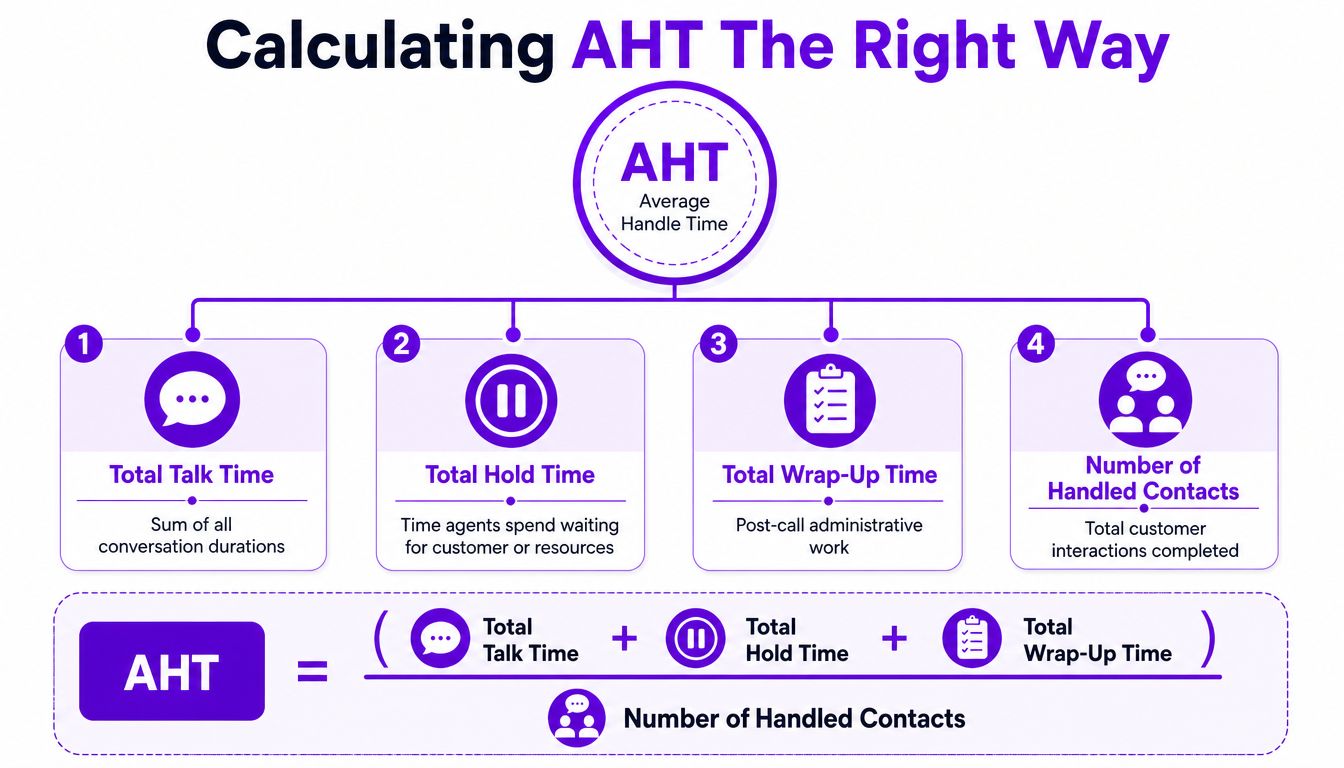
An AHT figure is only decision-grade if every minute of labour is counted the same way across teams, channels, and reporting periods. The standard definition used by NICE CXone's guide to average handle time includes the full handling cycle: customer conversation, time on hold, and the work required to complete the case after the interaction ends.
AHT = (Talk Time + Hold Time + After-Call Work) / Total Number of Handled Interactions
The formula is simple. The governance is not.
Boards often receive a single AHT number as if it were a neutral operational fact. In practice, that number reflects a series of measurement choices. If one business unit excludes after-call work, another removes transfers, and a third mixes chat and voice in the same denominator, the reported average stops being a management tool and becomes a reporting artefact.
What belongs in the calculation
AHT should be built from four auditable elements:
Talk time
The live interaction between customer and agent. This is the visible part of service delivery, but it is only one part.Hold time
Time the customer spends waiting while the agent searches for information, switches systems, seeks approval, or completes a task mid-contact.After-call work
Also called wrap-up or ACW. This includes notes, CRM updates, dispositions, compliance records, follow-up messages, and any post-contact administration needed to close the case correctly.Total handled interactions
The denominator should include the contacts your operation handled. If reporting rules exclude transfers, callbacks, or certain digital contacts, the average can look better while labour consumption stays unchanged.
That distinction matters because AHT is not one metric in economic terms. It is a portfolio of time categories with different causes and different strategic consequences. A minute removed from hold time often improves both cost and customer experience. A minute removed from talk time can improve cost while reducing first-contact resolution or trust if agents begin rushing complex conversations.
A worked example leaders can audit
Take a help desk queue with the following average components across handled contacts:
- Talk time: 8 minutes
- Hold time: 2 minutes
- After-call work: 1.5 minutes
AHT is 11.5 minutes.
The arithmetic is straightforward. The operating implication is more important. In this example, 3.5 minutes, nearly a third of total handling time, sits outside the live conversation. That changes the board-level question from “Why are agents on calls so long?” to “How much of this time reflects avoidable process load rather than customer need?”
| Component | What it may indicate | Typical leadership response |
|---|---|---|
| Talk time | Complexity, poor call routing, weak agent knowledge, customers needing reassurance | Segment by contact type before setting targets |
| Hold time | Slow systems, fragmented knowledge, approval delays, identity verification friction | Remove workflow bottlenecks and reduce system switching |
| After-call work | Manual admin, poor CRM design, compliance overhead, duplicate data entry | Automate summaries, simplify forms, redesign case closure steps |
Trustworthy AHT reporting requires leaders to inspect the composition of time, not just the average.
This is why broad mandates to “cut AHT” usually disappoint. If inflation sits in wrap-up, more coaching on call control will produce little savings and may damage service quality. Teams evaluating practical AI solutions for reducing AHT get better outcomes when they isolate which component is creating avoidable work and target that source directly.
For operations leaders, the next audit point is measurement consistency. Review whether talk, hold, and wrap-up are defined the same way inside your talk time reporting model, across queues and channels. That discipline is what turns AHT from a dashboard average into a metric a CXO can use for pricing, staffing, service design, and margin improvement.
The Business Impact of Every Second Saved
A one-second reduction in average handle time saves about 28 agent hours for every 100,000 calls, according to the ICMI Erlang calculator and staffing assumptions used in workforce planning. At scale, that is not a reporting footnote. It is a margin variable.

For a board, the question is not whether seconds matter. The question is which seconds matter. Time removed from avoidable hold, duplicate verification, or manual after-call administration lowers cost without reducing service quality. Time removed from diagnosis, reassurance, or issue resolution can lower cost on paper while increasing repeat demand, complaints, and churn.
That distinction turns AHT into a strategic trade-off, not a simple efficiency target.
Why AHT is really a cost architecture metric
AHT influences three financial lines at once: labour cost, revenue protection, and capacity to grow without adding headcount. SQM Group's first call resolution research shows that resolving an issue on the first contact has a far larger effect on customer satisfaction than shortening the interaction itself. The operating implication is clear. A shorter call that creates a second call is usually more expensive than a longer call that ends the matter.
This is why high-performing operators separate productive time from failure demand. If a customer is placed on hold because an agent must rekey data across systems, that time is pure operational drag. If the extra minute is spent confirming clinical details, explaining a billing change, or preventing a compliance error, it may be economically justified.
The same AHT reduction can therefore produce two very different outcomes:
- Good AHT reduction removes non-value work such as system switching, repeated authentication, dead air, and manual wrap-up.
- Bad AHT reduction shortens discovery, pushes agents to rush, and shifts unresolved work into callbacks, complaints, or churn.
Executives should treat those as separate categories in performance reviews.
The profit effect is real, but the path matters
Labour economics make the case for action. Contact centres remain people-intensive operations, and Deloitte's Global Contact Center Survey has long shown that labour is the largest share of operating cost in the function. Reducing avoidable handling time increases available capacity before a company hires more agents, expands outsourcing, or accepts lower service levels.
There is also a queueing effect. Shorter handling times improve throughput, which reduces wait times when demand spikes. Lower waits can protect conversion in sales and retention environments where customers abandon quickly. Yet the financial gain disappears if shorter contacts reduce resolution quality and create rework later in the journey.
That is the core strategic error in the usual “lower is better” mantra. It assumes all seconds carry the same economic value. They do not.
The right target is the efficient resolution point
AHT performs best as part of a portfolio that includes first contact resolution, repeat contact rate, customer satisfaction, and quality assurance. McKinsey's work on customer care transformation has argued that leading service organisations improve both cost and experience by removing friction from the journey, not by forcing agents to finish faster. That is a different management philosophy. It focuses on redesigning work.
Consider the practical contrast:
- A simple balance query or delivery-status call should be handled quickly because the customer wants speed and certainty.
- A fraud alert, healthcare booking, or technical troubleshooting interaction often deserves more time because the value lies in accuracy, trust, and prevention of downstream failure.
Board oversight should reflect that reality. If AHT falls, leadership should ask whether first contact resolution held steady, whether repeat contacts dropped, and whether quality scores improved in the same period. If those indicators move in the wrong direction, the organisation has not gained efficiency. It has deferred cost.
Voice AI changes the economics because it can reduce non-value seconds without forcing the traditional trade-off between speed and service. Used well, it can automate identification and verification steps, guide agents in real time, retrieve knowledge instantly, and complete post-call summaries. That shifts time out of hold and wrap-up while preserving, or improving, the quality of the live conversation.
For CXOs, that is the strategic opportunity. The goal is not the shortest interaction. The goal is the lowest-cost path to a satisfactory, loyal, and commercially valuable customer outcome.
Industry-Specific AHT Benchmarks and Targets for 2026
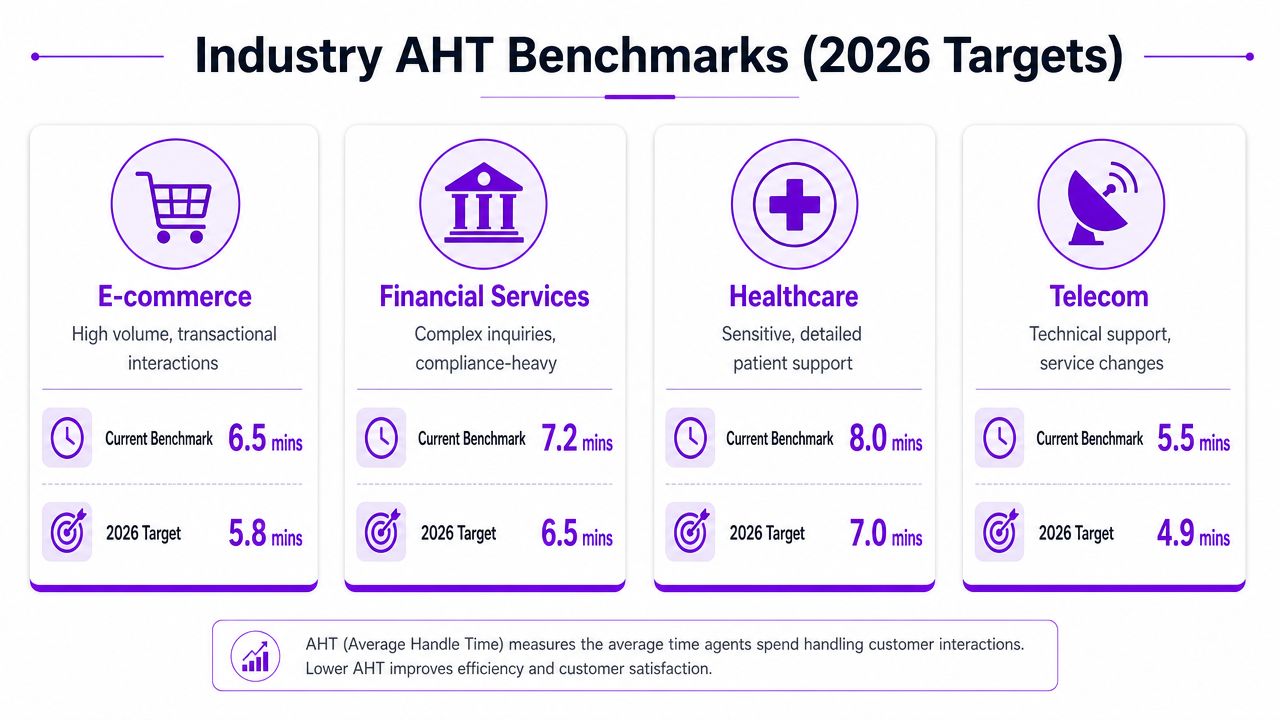
SQM Group has reported that, across call centres it benchmarks, average handle time often falls in a band of roughly 4 to 8 minutes depending on contact type and operating model. That range is more useful to directors than any single blended average because it reflects a basic operating truth. A retail delivery query, a mortgage-servicing call, and a software troubleshooting case do not create value in the same way, so they should not be managed to the same time target.
Benchmarks matter. Uniform targets usually destroy insight.
AHT should be set by interaction economics, compliance load, and the cost of failure. In low-complexity environments, a longer call often signals broken self-service, poor order visibility, or avoidable transfers. In high-stakes environments, a longer call may be the rational price of accuracy, trust, and lower downstream risk. That is why leading operators treat AHT as a portfolio metric across contact reasons, channels, and customer segments rather than a single efficiency number for the whole estate.
What the benchmark means by sector
The right comparison group is narrower than many teams assume. Industry matters, but call reason matters more. A payments dispute in BFSI has more in common with a fraud review than with a balance enquiry. A SaaS password reset has more in common with e-commerce order tracking than with enterprise technical support.
That distinction matters for target setting:
E-commerce
Targets should sit at the lower end of the range because a large share of contacts are transactional. Rising AHT often points to preventable friction, such as weak order tracking, return-policy confusion, or fragmented agent tools.EdTech
Sales and counselling interactions usually justify more time than basic service contacts. The commercial question is whether longer conversations improve enrolment quality, show-up rates, and revenue per acquired student.Real estate
Qualification calls often carry high economic value per interaction. A short call that fails to establish budget, timeline, or purchase intent can reduce site visits and waste follow-up spend.BFSI
Higher AHT can be structurally rational because identity checks, fraud controls, disclosures, and case documentation add work. Boards should judge performance against loss prevention, resolution quality, and regulatory adherence alongside speed.Healthcare
Scheduling, benefits clarification, and clinical-adjacent queries require precision. Here, avoidable delay should be removed, but conversational time that reduces patient confusion or missed appointments can create financial value.SaaS and software support
Technical support often sits at the upper end of the benchmark range because diagnosis is iterative. The stronger question is whether time is spent solving the problem or searching for context, knowledge, and prior case history.
A practical target table for directors
The right target is usually a range with clear guardrails on quality, repeat contact, and conversion.
| Industry | Target AHT Range | Key Influencing Factors |
|---|---|---|
| E-commerce | Lower end of benchmark range | High volume, transactional issues, order status, returns |
| EdTech | Mid-range, depending on qualification depth | Counselling, lead qualification, programme fit, trust-building |
| Real estate | Mid-range, with high commercial value per call | Discovery, budget qualification, booking intent |
| BFSI | Upper end for regulated and dispute-heavy contacts | Compliance checks, KYC, account verification, risk controls |
| Healthcare | Mid-to-upper range, depending on scheduling and complexity | Sensitive queries, patient detail, scheduling accuracy |
| SaaS and software support | Upper end of benchmark range | Troubleshooting depth, technical context, multi-step resolution |
This is the strategic trade-off many boards miss. Cutting AHT in one part of the portfolio can improve labour productivity while inadvertently damaging conversion, first-contact resolution, or customer confidence in another. The management task is to remove non-value seconds without compressing the parts of the interaction that create trust or reduce future cost.
That is also why automation decisions should be tied to contact type, not applied as a blanket policy. Well-designed contact center automation strategies can shorten verification, routing, knowledge retrieval, and after-call work in almost every sector. They should not force complex, high-value conversations into an artificially low time box.
A practical 2026 rule is simple. If AHT sits above target, isolate whether the excess comes from justified complexity or operational drag. Only operational drag should be treated as waste.
Four Levers to Reduce AHT and Boost Efficiency
AHT improves fastest when leaders treat it as an operating model issue, not an agent discipline issue. The practical question is simple. Which seconds create value, and which seconds exist because the organisation designed avoidable friction into the journey?
That distinction matters at board level because every wasted minute carries two costs at once: higher service labour and lower capacity. In a constrained labour market, reducing non-value time is often cheaper and faster than adding headcount.
1. Redesign process flow before asking agents to work faster
A large share of handle time inflation comes from poor process architecture. Agents wait for systems to load, repeat authentication steps, re-enter data, and transfer contacts that should have been routed correctly at the start. None of that improves the customer outcome.
The highest-return fixes are usually unglamorous:
- Remove duplicate steps: Cut repeated verification, unnecessary approval loops, and hand-offs with no decision value.
- Reduce after-call work: Use structured fields, cleaner CRM workflows, and fewer free-text notes where compliance allows.
- Standardise exception handling: Give agents a defined path for common edge cases so they do not improvise or escalate unnecessarily.
This is often the fastest route to lower AHT because it strips out work that customers never wanted and the business never needed.
2. Improve knowledge access and decision support
Long calls are frequently a search problem disguised as a performance problem. If agents hunt across PDFs, shared drives, ticket histories, and outdated playbooks, handle time rises even when the agent is competent.
Better knowledge design cuts delay in three places. It reduces time to diagnosis, reduces hesitation during the interaction, and reduces post-call clean-up caused by incomplete guidance. The strongest centres maintain one current source of truth for policies, product changes, troubleshooting flows, and compliance language.
A useful management test is whether experienced agents still place customers on hold to confirm basic answers. If they do, the knowledge environment is adding cost.
3. Match contact complexity to skill and context
Routing quality shapes AHT more than many operating reviews acknowledge. When a high-friction billing dispute lands with a generalist, or a retention risk reaches an agent without account history, the conversation becomes longer, less confident, and more likely to create repeat demand.
Two controls matter most:
Skill-based routing
Send contacts to the team most likely to resolve them on the first attempt.Pre-contact context
Surface prior interactions, account status, product history, and intent signals before the conversation begins.
Training still matters, but training has diminishing returns when routing logic is weak. Leaders considering broader contact centre automation strategy programmes should prioritise this layer because it improves both speed and resolution quality.
Operating principle: Do not ask frontline teams to absorb structural defects through extra effort.
4. Use Voice AI to remove friction without compressing high-value conversations
Traditional AHT programmes often force a trade-off. Cost falls, but service quality, conversion, or customer trust falls with it. Voice AI changes that equation when it is applied to the right parts of the contact portfolio.
The best use cases are not the conversations where human judgement creates value. They are the seconds around the conversation, and the repetitive steps within it. Voice AI can handle identity capture, intent detection, routine requests, real-time knowledge prompts, and automated summaries. That shortens handling time by removing dead time rather than by rushing the customer.
Industry research from IBM on AI in customer service describes this pattern clearly: the gains come from faster access to information, better self-service for simple issues, and more productive agent support during live interactions. Those mechanisms matter more than any single headline number because they explain why some AI deployments reduce AHT while preserving customer outcomes, and others automate poor process design.
For executives, that is the key strategic break from older efficiency programmes. Voice AI allows the organisation to lower cost-to-serve in low-complexity contacts while preserving time for the interactions that protect revenue, retention, and compliance.
A short demonstration helps make that future more tangible:
The board-level question is therefore narrower and more useful than "Can AI reduce AHT?" The better question is whether the operating model removes waste seconds while protecting the parts of the interaction that drive first-contact resolution, trust, and lifetime value.
Avoiding Common AHT Pitfalls and Future-Proofing Your Strategy
An executive team can damage a contact centre by rewarding the wrong version of improvement. If managers praise low AHT without checking resolution quality, agents quickly learn to optimise for the clock rather than for the customer.
That creates predictable failures. Customers repeat themselves. Complex issues bounce between teams. Staff morale falls because employees know they're being measured on speed while being blamed for poor outcomes. High AHT can sometimes be a bad sign, but in some contexts it can also indicate that an agent took the time to resolve a difficult issue properly.
When lower AHT becomes a bad result
The warning signs are usually visible before the financial impact appears.
- Agents sound hurried: Customers feel processed rather than helped.
- Complex issues are cut short: The immediate interaction ends quickly, but the underlying problem remains.
- Employee frustration rises: Staff carry the tension of impossible targets and messy systems.
- Performance reviews become distorted: People who close calls fast may look better than people who solve problems well.
The right target isn't the lowest average handling time. It's the best balance between speed, quality, and sustainable workload.
What boards should ask next
Board oversight improves sharply when AHT is treated as one metric in a balanced operating model. Directors should ask:
| Board question | Why it matters |
|---|---|
| Is AHT rising because of complexity or inefficiency? | Prevents false diagnosis |
| Which component is inflating AHT most? | Focuses investment on the real bottleneck |
| Are teams trading quality for speed? | Protects loyalty and brand trust |
| Which interactions should be automated, assisted, or escalated? | Guides future operating design |
The future-proof strategy is not “reduce every call”. It is “design every interaction appropriately”. Some contacts need empathy and depth. Others need immediate, frictionless completion. AI and automation matter because they help organisations make that distinction at scale, with greater consistency than manual operations alone.
If your organisation wants to turn average handling time from a reactive KPI into a strategic advantage, DialNexa Labs Private Limited offers human-like Voice AI agents for qualification, customer support, recruitment, and presales workflows across EdTech, BFSI, real estate, e-commerce, software, hospitality, and healthcare. Their platform is built for teams that want to reduce repetitive workload, standardise conversations, and scale service operations without sacrificing responsiveness or control.

Leave a Reply