

The Modern IVR Contact Center: Your Guide to Strategic Growth
An Interactive Voice Response (IVR) system in a contact centre is an automated phone menu, designed to guide callers to the right person or information without needing a human agent for every call. A modern IVR contact centre, however, is a different beast entirely. It leverages Artificial Intelligence to understand natural language, letting it resolve complex customer issues and even drive sales autonomously. For a Director of Operations or a VP of Sales, this isn't just a phone system; it's a strategic asset for scaling the business efficiently.
Why a Modern IVR Contact Center Is a Growth Multiplier
For years, IVR was a necessary evil—that rigid, impersonal voice telling you to "press 1 for sales," a system that research from sources like Harris Interactive showed caused up to 60% of customers to hang up in frustration. That reputation is completely outdated. Today’s AI-driven IVR contact centre is a powerful asset that doesn’t just cut costs—it actively drives revenue and provides a significant competitive advantage.
Think of it as swapping an old-school manual telephone switchboard for an intelligent, digital workforce. The old system merely patched calls through. This new workforce automates a massive volume of repetitive tasks with an accuracy level that rivals, and often surpasses, human agents.
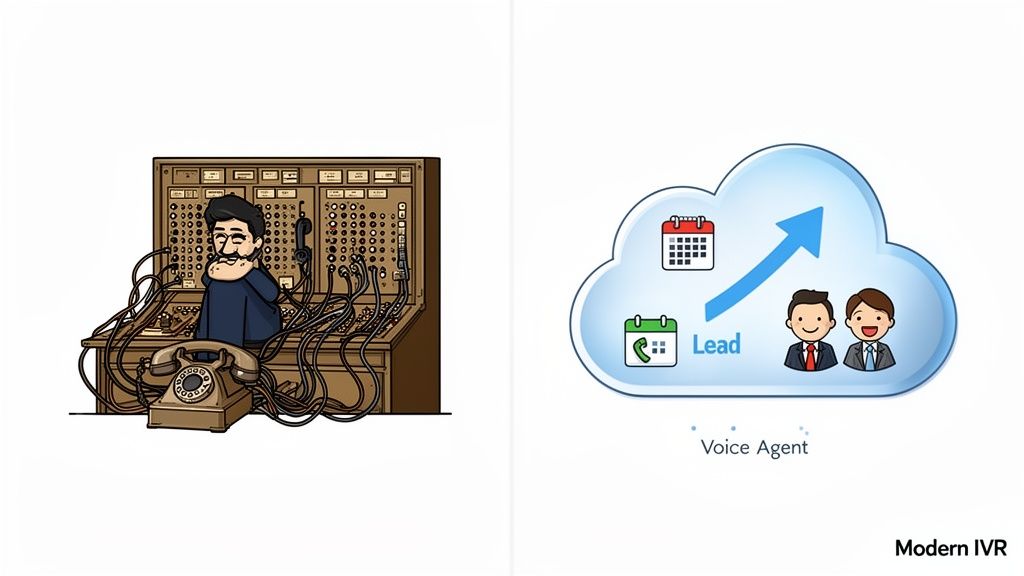
From Cost Centre to Growth Engine
This technological leap fundamentally changes the P&L equation. By automating routine jobs like qualifying thousands of inbound leads, scheduling sales demos, or confirming order statuses, you free up your most valuable resource—your skilled human team. They can then focus on high-value, strategic work that requires empathy, negotiation, and complex problem-solving.
This strategic reallocation delivers tangible results that directly impact the bottom line:
- Accelerated Sales Cycles: Imagine an AI-powered agent qualifying 10,000 leads in a single day with 97% accuracy. This ensures your sales team invests their time exclusively on prospects who are pre-vetted and ready for a serious conversation, shortening the sales cycle by weeks.
- Drastically Lower Operational Costs: A leading tech firm was able to handle a 300% surge in customer inquiries during a product launch without hiring a single additional agent. A single AI agent can manage the communication workload of an entire team at a fraction of the cost.
- Enhanced Customer Lifetime Value (CLV): When customers get instant, 24/7 answers through a natural conversation, they stay loyal. According to Bain & Company, a 5% increase in customer retention can increase profitability by 75%. An effective IVR contact center directly contributes to this.
The table below outlines the strategic shift from a tactical cost-saving tool to a genuine growth driver.
Legacy IVR vs Modern IVR Contact Center
| Attribute | Legacy IVR (The Cost Center) | Modern IVR Contact Center (The Growth Engine) |
|---|---|---|
| Primary Goal | Deflect calls, reduce agent headcount | Resolve issues, create sales opportunities, capture data |
| User Experience | Rigid, menu-based ("Press 1, Press 2") | Conversational, natural language understanding |
| Capability | Simple call routing | End-to-end task automation (scheduling, lead qualification, payment processing) |
| Availability | Fixed business hours | 24/7/365, instantly scalable to handle any volume |
| Business Impact | High abandonment (often >40%), customer frustration | Increased customer loyalty, higher conversion rates (up to 4x) |
| Financial Role | An operational expense to be minimised | A revenue-generating asset with a clear, measurable ROI |
This comparison makes it clear: we're no longer just managing calls. We're building an automated engine for business growth, turning a traditional cost centre into a proactive, revenue-focused powerhouse.
The Strategic Value of Automation
The true power of a modern IVR contact centre isn’t measured by how many calls it deflects, but by how many opportunities it creates and converts. For growing companies, exploring effective call center software for small business is the first practical step toward realising this strategic vision.
A well-implemented conversational IVR can boost call connect rates from an industry average of 47% to over 91%. That means nearly doubling the number of productive conversations from your outreach efforts.
This isn't a futuristic concept; it's a proven reality. In EdTech, an AI agent can counsel thousands of prospective students about courses and schedule admissions interviews 24/7. In real estate, it can pre-qualify leads for a new property and book site visits instantly, ensuring no high-intent prospect is ever lost.
Moving from a simple call-routing tool to a core business driver allows a CXO to reinvest the team's talent into innovation, strategic planning, and building the high-touch customer relationships that fuel long-term, sustainable growth.
From Touch-Tone Menus to AI Conversations
To truly appreciate the strategic impact of a modern IVR contact centre, it’s useful to understand its evolution. This technology has progressed from a clunky, frustrating phone menu into a sophisticated tool for intelligent customer engagement. For a C-level executive, this journey represents a shift from a brand liability to a brand asset.
This isn't a simple tech upgrade. It’s a complete rethinking of how businesses communicate at scale. It’s the difference between trapping a high-value customer in a maze and guiding them to a productive outcome.
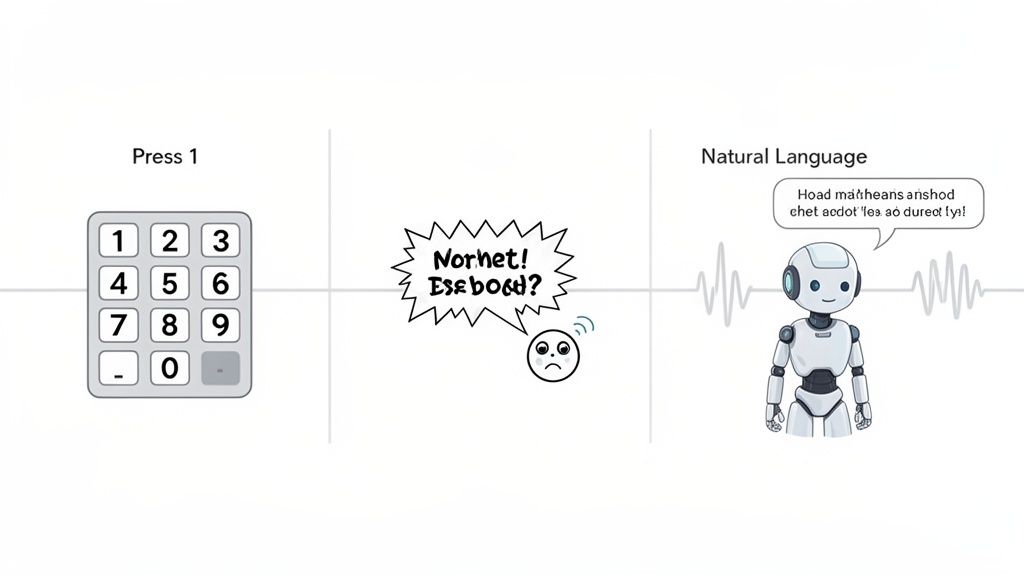
The Era of Touch-Tone DTMF
The first IVR systems ran on Dual-Tone Multi-Frequency (DTMF)—the "Press 1 for Sales, Press 2 for Support" world. While functional for basic call routing, these systems were incredibly inflexible. Customers were forced to navigate a confusing decision tree, and one wrong press often meant restarting the entire frustrating process. Studies consistently showed that over 40% of customers would abandon the call if the menu was too complex. For any business leader, that represents a massive, quantifiable leakage of revenue and customer trust.
Early Speech Recognition: A Step Forward
The next phase introduced basic speech recognition. Callers could say simple keywords like "Sales" or "Billing." It was a step toward a more natural interaction, but these early systems were easily confounded.
Common failure points included:
- Accents and Dialects: Regional accents often confused the system, forcing a fallback to the touch-tone menu.
- Background Noise: A busy office or a car journey could completely derail the interaction.
- Limited Vocabulary: The IVR only understood a small list of pre-programmed words, rendering it useless for any request outside of its narrow script.
This technology was a necessary stepping stone, but it couldn't deliver the seamless experience customers were beginning to demand. It was still more of a directory than a problem-solver.
The Leap to Conversational AI
The true paradigm shift arrived with advanced Natural Language Processing (NLP) and Voice AI. This is where we moved from a rigid script to an intelligent, two-way dialogue. A modern IVR contact centre doesn't just listen for keywords; it understands intent, context, and sentiment.
Think of it this way: a touch-tone IVR is a multiple-choice quiz; the user is restricted to pre-defined answers. A conversational IVR is an essay question; it understands the user's intent, no matter how they phrase their request.
This is powered by sophisticated algorithms that can manage multi-turn conversations, ask clarifying questions, and adapt its responses based on the caller's input. For those interested in the underlying technology, the evolution of conversation design provides deeper insight.
For a COO or VP of Customer Experience, this leap means customers can finally just state their problem in their own words—"I need to track my recent order and update the delivery address for next Tuesday"—and the system can process both parts of that request in a single interaction. This efficiency directly translates to higher first-call resolution rates, improved CSAT scores, and a stronger, more modern brand perception.
Measuring the ROI of Your IVR Contact Centre
Investing in a modern IVR contact centre is not an operational expense—it's a strategic investment with a clear and compelling return. For any executive, the crucial question is always about the bottom line. The true value lies in tangible improvements to operational efficiency, revenue generation, and customer retention.
An intelligent IVR system acts as a force multiplier for your team. It automates the high-volume, low-complexity interactions, freeing up your expert agents to focus on the high-value conversations that drive business growth. The financial impact of this strategic shift is both immediate and substantial.
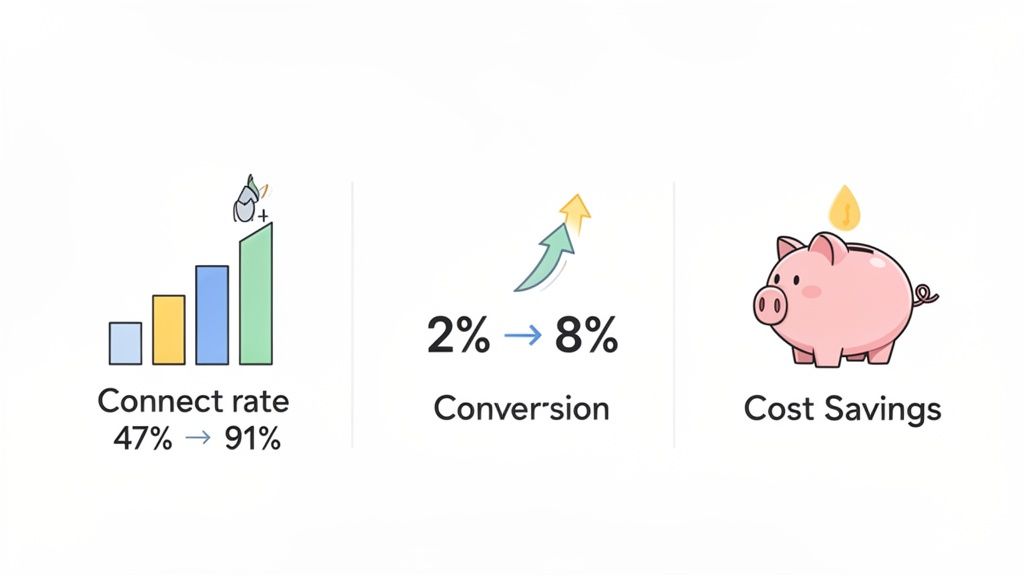
Driving Revenue with Enhanced Lead Conversion
One of the most powerful arguments for an advanced IVR is its direct impact on the sales funnel. By automating top-of-funnel activities, an AI-powered system ensures no lead is ever missed and every prospect is engaged instantly and consistently.
Consider the traditional outbound sales process, where agents struggle with low connection rates. A modern IVR contact centre completely transforms this dynamic.
- Boosted Connect Rates: Deployments consistently show call connect rates jumping from a typical 47% to over 91%. This is achieved through relentless, automated dialing and intelligent scheduling algorithms that ensure your message reaches far more potential customers.
- Accelerated Lead-to-Booking: More connections drive more opportunities. We’ve seen clients increase their lead-to-booking conversion rates from an industry standard of 2% to as high as 8%—a 4x improvement. An AI agent can qualify a lead and book a demo or site visit on the first call, dramatically shortening the sales cycle.
- Superior Lead Quality: AI-qualified leads achieve 97% accuracy, on par with human judgment. This ensures your high-cost sales team invests their time only on prospects with genuine interest and budget, boosting morale and close rates.
By automating initial lead qualification, a VP of Sales can shift their team's focus from cold outreach to closing deals with pre-vetted, high-intent buyers. This transition alone can redefine the productivity and profitability of an entire sales organization.
Slashing Operational Costs Through Automation
While revenue generation is the primary goal, the cost-saving power of an IVR contact centre is equally compelling for a CFO. Automation enables you to scale operations without proportionally scaling headcount, directly improving your operational margin.
For example, an EdTech platform can handle thousands of daily admission inquiries during peak season without hiring a massive team of temporary staff, saving upwards of $100,000 in seasonal hiring costs. A real estate firm can manage appointment bookings for dozens of properties 24/7 without paying for agent overtime. This efficiency is the foundation of a healthy bottom line.
To gain an accurate picture of the financial impact and fine-tune your IVR's performance, robust call tracking is essential. For a comprehensive approach, this marketing attribution phone calls tracking guide is an invaluable resource.
The Growing Market and Strategic Advantage
The strategic importance of this technology is clearly reflected in market trends. In India's dynamic contact centre market, Contact Centre as a Service (CCaaS) has become a growth engine. This directly benefits businesses like DialNexa, which provides IVR-driven AI agents for crucial sectors like EdTech, BFSI, real estate, and e-commerce.
Recent market analysis shows this segment generated USD 229.5 million in revenue, proving the high demand for flexible, cloud-based solutions. Even more impressive, projections show it soaring to USD 821.7 million by 2030, driven by an incredible compound annual growth rate of 24.3%.
This explosive growth makes one thing clear: IVR-integrated CCaaS is fundamentally changing customer interactions. The financial return isn't some far-off theory; it's a proven reality for businesses that adopt this tech to get ahead. To take a closer look at the specific metrics that spell success, check out our guide on key performance indicators for voice agents.
Where IVR Really Shines: Real-World Industry Wins
The theoretical benefits of technology are irrelevant to a business leader; what matters is the competitive edge it creates in your specific market. The true value of a modern IVR contact center becomes clear when you see it solving the high-stakes, industry-specific problems that impact your P&L.
A modern IVR is not a one-size-fits-all tool but a specialist configured to speak the language of your business. This is what transforms a call-handling system into a strategic asset. Whether it’s qualifying property leads 24/7 or guiding a student through a complex admissions process, the goal is always a measurable business outcome.
Let's examine concrete scenarios to see how this technology delivers a clear return on investment.
EdTech: Streamlining the Student Journey
The education sector faces a deluge of inquiries during admissions season. An AI-powered IVR contact center acts as a 24/7 admissions counselor, ensuring no prospective student's query is ever missed.
Practical Example: An AI agent handles thousands of simultaneous calls, providing details on program specifics, fee structures, and scholarship eligibility. It then pre-qualifies candidates based on academic interests and seamlessly schedules interviews with human admissions officers, populating their calendars exclusively with high-potential applicants.
- Pain Point Solved: Admissions teams are overwhelmed by call volume, leading to slow response times and lost applicants.
- Business Outcome: A 25-30% increase in qualified applications and a shorter admissions cycle, helping institutions secure top talent ahead of competitors.
BFSI: Nailing Compliance and Instant Support
In banking, finance, and insurance (BFSI), security, compliance, and speed are non-negotiable. An intelligent IVR provides a secure and efficient channel for customers to handle sensitive tasks, reducing both risk and operational overhead.
Practical Example: A compliant AI voice agent guides a customer through the Know Your Customer (KYC) process, collecting required information and verifying it against backend systems in real-time. For a trading platform, it can provide secure account balances or answer questions about market orders, freeing up licensed financial advisors for high-value advisory work.
A well-designed IVR in the financial sector can slash call handling times for routine identity verification by up to 80%, while simultaneously strengthening security protocols and creating a perfect audit trail for compliance.
This automation improves customer satisfaction and simplifies regulatory reporting.
Real Estate: Never Missing Another Lead
In the fast-paced real estate market, a missed call is a lost sale. An IVR contact center serves as a tireless virtual assistant, capturing and qualifying every inquiry the moment it arrives.
Practical Example: A potential buyer calls about a listing. The AI agent provides key details like price and availability, then asks intelligent qualifying questions: "What is your budget?" "What is your move-in timeline?" "Are you pre-approved for a mortgage?" High-intent leads are prompted to book a site visit instantly, with the appointment synced directly to a broker’s calendar.
- Pain Point Solved: High-value leads are lost because agents are busy or calls come in after hours.
- Business Outcome: Sales agents spend their time showing properties to pre-qualified, ready-to-buy clients, dramatically increasing their productivity and conversion rates.
E-commerce: Managing the Rush Without a Hitch
E-commerce businesses are defined by their customer service, especially during peak seasons and sales events. An intelligent IVR can absorb massive spikes in call volume, handling common queries like order status, returns, and refunds without the need for costly temporary staff.
Practical Example: A customer calls asking, "Where is my order?" The IVR authenticates them, pulls their recent purchase data from the CRM, provides a real-time shipping update from the logistics partner's API, and offers to send a tracking link via SMS. It can even initiate a return and email a shipping label, all in one automated conversation. This self-service efficiency can deflect over 40% of calls from human agents during peak periods.
This automation is supported by a robust ecosystem. The IVR service provider landscape in India, for example, offers cloud solutions designed to reduce call abandonment by up to 40% through smarter flows, allowing businesses to scale to thousands of daily calls with connect rates as high as 91%. You can learn more about leading IVR providers on Bonvoice.com. By automating routine tasks, your team can focus on resolving complex issues that require a human touch, protecting your brand's reputation for excellent service.
Weaving Your IVR into the Fabric of Your Operations
Adopting new technology often raises concerns among leadership about disruption, hidden costs, and lengthy implementation cycles. The critical question is: will this new system create more problems than it solves?
A modern IVR contact centre is engineered to mitigate these concerns. It is designed as an agile, intelligent layer that enhances your existing operational framework, not as a disruptive force requiring a complete overhaul.
The key to this seamless integration is its cloud-native architecture. We have moved beyond the era of on-premise systems that required massive capital expenditure on hardware and months of custom coding. Today’s solutions are built for speed and flexibility, connecting to your existing tech stack with minimal friction. It functions as a plug-and-play strategic component for your business.
The Power of API-Driven Connectivity
The magic behind this seamless integration lies in Application Programming Interfaces (APIs). An API acts as a universal translator, allowing disparate software systems to communicate effortlessly. A well-designed IVR contact centre uses a robust set of APIs to connect directly into the tools your teams rely on daily.
In practical terms for a Director of IT or Operations, this means your Voice AI agent can:
- Pull customer history from your Salesforce or HubSpot CRM to personalize the conversation.
- Log call outcomes and new lead data directly into your Zendesk or ServiceNow platform, eliminating manual data entry.
- Book appointments that appear instantly in your team’s Google or Outlook calendars.
This deep, bi-directional integration ensures a smooth flow of data across your entire organization, eliminating data silos and providing a single, unified view of the customer journey.
The key takeaway for any business leader is simple: modern IVR systems are built for agility. They don’t require you to rip and replace your existing infrastructure. Instead, they layer intelligent automation right on top of what you already have, delivering value in a fraction of the time.
This diagram illustrates how a central IVR solution can be configured to meet the unique needs of key sectors like EdTech, Real Estate, and E-commerce.
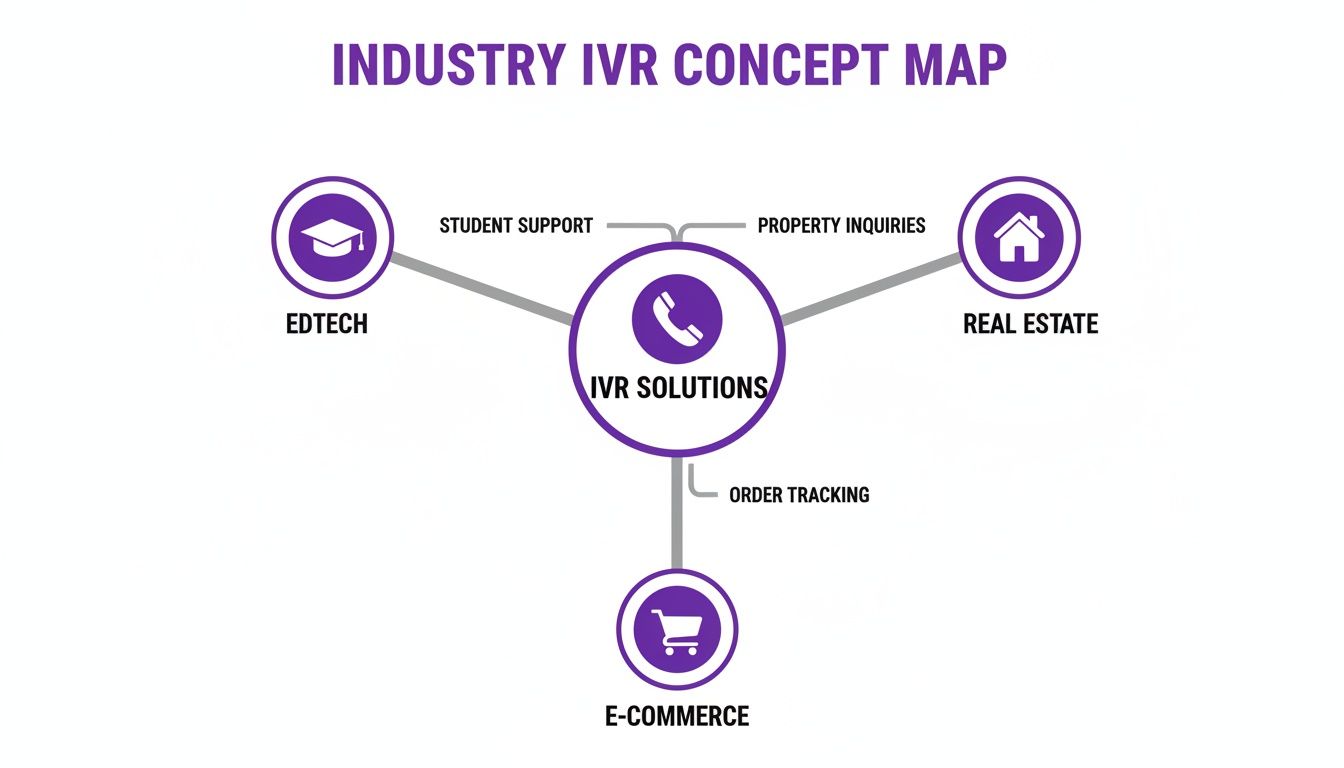
As shown, a single, adaptable IVR platform can be tailored to solve very specific industry challenges, from handling student admissions to securing property bookings.
Empowering Teams with No-Code Dashboards
Another critical innovation is the rise of intuitive, no-code dashboards. The days of needing a team of developers to build or modify a call flow are over. Modern platforms, such as those from DialNexa, empower your operational teams—the people who know your customers best—to design, launch, and iterate on custom voice agents themselves.
This "self-service" approach enables real-time business agility. Need to launch a new marketing campaign or update a customer support script for a product recall? Your team can execute these changes in hours, not weeks.
The market validates this agile approach. India's contact centre software market, a key enabler for any advanced IVR contact centre, is projected to grow at a compound annual growth rate (CAGR) of 21.72%, reaching $3,113.93 million by 2028. This growth is fueled by the tight integration of IVR with technologies like automatic speech recognition, creating unified platforms that innovators in BFSI, real estate, and EdTech rely on. You can explore this market growth on inkwoodresearch.com. For leadership, this confirms that investing in a modern IVR isn't a gamble; it's aligning with a massive, sustained industry shift toward intelligent automation.
Your Top IVR Implementation Questions, Answered
Even with clear benefits, adopting new technology always raises practical questions. For an executive, the decision to invest in a modern IVR contact centre hinges on getting direct answers about deployment, capabilities, and performance measurement. Let's address the most common questions from leadership to provide the clarity needed to move forward confidently.
How Quickly Can We Get a Modern IVR Contact Centre Up and Running?
This is a critical concern for any fast-moving organization. The good news is that year-long implementation projects are a relic of the past. Thanks to cloud-native platforms and API-first architecture, the deployment timeline has been dramatically compressed.
Practical Timeline: For a standard implementation, a powerful, AI-driven IVR system can be fully operational in 4 to 6 weeks. The process typically involves a two-week discovery and design phase, followed by a two-to-four-week period for configuration, integration with your CRM, and testing. Since there is no physical hardware to install, the process is minimally disruptive to daily operations.
Can an AI Agent Actually Handle Our Industry Jargon and Compliance?
Absolutely. This is where a modern voice agent demonstrates its true value. It is not a generic, off-the-shelf tool but a specialist trained on your specific business context. During setup, the AI is trained on your company's lexicon, product names, industry acronyms, and common customer queries.
Practical Examples:
- An EdTech agent is trained to differentiate between a "postgraduate diploma" and a "master's degree" and understands the nuances of various entrance exams.
- A BFSI agent is trained on precise, regulator-approved compliance scripts for KYC verification and understands terms like "equity trading" vs. "mutual funds."
- A real estate agent is taught to distinguish between a "2BHK" and a "duplex apartment" and can discuss concepts like "carpet area" and "super built-up area."
This bespoke training ensures the agent communicates with the same precision and context as your best human agents, which is crucial for building customer trust.
A well-trained voice AI can achieve 97% accuracy in lead qualification, on par with human judgment. This is possible precisely because it’s trained to understand the specific nuances and terminology of your business.
This level of customization ensures every conversation is relevant, compliant, and perfectly aligned with your brand voice.
What Are the Most Common Mistakes We Should Avoid?
While implementation is simpler today, several strategic pitfalls can undermine success. Avoiding these common errors is key to maximizing your ROI.
- Designing a Complicated Call Flow: The goal is to simplify the customer journey, not replicate a confusing internal process. Avoid long menus or asking for excessive information upfront. Best practice is to design a natural, conversational path that resolves the caller's primary intent as quickly as possible.
- Forgetting the "Escape Hatch": Automation is powerful, but there will always be complex or emotionally charged situations that require human intervention. Always provide a clear, simple option for a caller to escalate to a live agent. Hiding this option is the fastest way to create customer frustration.
- Neglecting Post-Launch Optimisation: An IVR is not a "set it and forget it" tool. It is critical to continuously monitor call logs, analyze conversation data, and review customer feedback. This data-driven improvement cycle allows you to refine scripts, improve resolution rates, and boost performance over time.
Avoiding these traps ensures your IVR contact centre becomes an asset that customers value, rather than another frustrating phone system.
How Do We Measure Success Beyond Just Saving Money?
Reducing operational costs is a significant benefit, but it's only part of the story. A successful IVR contact centre is a growth engine. To get a complete picture of your ROI, you must track a balanced scorecard of Key Performance Indicators (KPIs).
Here are the critical metrics that matter most to leadership:
- Lead Quality Improvement: Are the leads passed to sales converting at a higher rate (e.g., from 15% to 25%)? This is hard proof that the AI is effectively filtering for high-intent prospects.
- Customer Satisfaction (CSAT) Scores: Are customers rating their automated interactions positively? Post-call surveys provide direct feedback. A score of 4.5/5 or higher is a strong indicator of success.
- First Call Resolution (FCR): What percentage of calls are fully resolved by the AI without human intervention? An FCR rate above 70% for common query types is a powerful indicator of efficiency.
- Call Abandonment Rate: With a modern IVR, this rate should drop from a typical 20-30% to under 5%. This demonstrates that you are capturing opportunities that were previously being lost.
By focusing on these growth-oriented metrics, you can clearly demonstrate that your IVR is not just a cost-cutting tool but a strategic engine for improving sales effectiveness and building stronger customer relationships.
Ready to see how a custom Voice AI agent can transform your customer conversations? DialNexa helps businesses across EdTech, real estate, and BFSI deploy intelligent agents that boost connect rates, qualify leads with 97% accuracy, and accelerate growth. Explore what’s possible at https://dialnexa.com.

[…] This first component acts as a smart, efficient front door for your entire customer experience, capable of increasing call containment rates by up to 40%. For a deeper dive, check out our guide on improving customer experience with an IVR contact centre. […]
I especially appreciate the practical industry examples and implementation guidance, showing how intelligent automation can enhance both operational efficiency and long-term customer loyalty.