
A CXO Guide to Call Center Outbound Calls
Outbound calls are all about being proactive. Instead of waiting for customers to come to you, your business reaches out to them—or to people who could become customers. It’s far more than just a sales tactic; when done right, outbound calling is a powerful way to win new business, conduct valuable market research, and offer proactive support. For a strategic leader, it's a direct line to fuelling real business growth.
Transforming Outbound Calls From Cost Centre to Growth Engine
For ages, many businesses have seen their outbound call centre as just another line item on the expense report—a necessary cost of doing business. But that view is outdated and misses the bigger picture. It's time for senior leaders to start thinking differently. A modern, well-run outbound operation isn’t a cost centre; it's a powerful engine for proactive growth.
This means we need to move past the old-school image of agents just hammering out cold calls all day. Your outbound team can, and should, be a primary driver for hitting major business goals.
- Speeding Up Revenue: They can connect directly with well-qualified leads, which helps to shorten the sales cycle and close deals much faster.
- Driving Customer Acquisition: They can reach entirely new segments of the market, converting prospects who might otherwise never have found your brand.
- Boosting Market Penetration: They gather immediate feedback from the ground and help build a stronger brand presence, especially in crowded markets.
The Strategic Value in Competitive Markets
Think about the hyper-competitive EdTech space. Here, an outbound team isn’t just selling courses. They’re acting as educational counsellors. They engage with potential students, take the time to understand their career aspirations, and guide them towards the best programme for their needs. This approach builds a foundation of trust and has a huge impact on enrolment rates, turning a single phone call into a lasting student relationship.
The same is true in real estate, where proactive call center outbound calls are absolutely essential. Agents can quickly follow up on website enquiries, book site visits for serious buyers, and keep long-term leads warm. In a noisy digital world, that direct, personal engagement ensures a potential buyer doesn’t get lost in the shuffle, leading directly to more property sales.
Any executive who's serious about growth is constantly thinking about three things: scalability, brand reputation, and return on investment. A smart outbound strategy hits all three, delivering measurable results that build on themselves over time.
For many companies, getting this kind of scale means looking for talent around the globe. For instance, outsourcing outbound call centre operations to India can lead to incredible cost savings of 40-70% compared to running the same setup in Western countries. It’s no wonder industries from real estate to finance rely on this model to maintain 24/7 operations and expand their reach. You can learn more about the benefits of outsourcing to India for call centers. This makes a strong business case for investing in outbound, repositioning it from a simple operational task to a core part of your expansion strategy.
Designing Your Modern Outbound Call Centre Blueprint
To stop seeing your outbound operation as just another expense on the balance sheet, you need to start treating it like a strategic asset. For senior leaders, this isn't about getting bogged down in the day-to-day calls. It’s about building a "revenue factory" where every single component is engineered for peak performance and impact. This blueprint stands on two critical pillars: defining the strategic why behind your calls and getting the right technology in place to make it happen.
Think of your outbound centre as a finely tuned assembly line. Your data and leads are the raw materials. Your tech stack is the machinery. Your agents are the skilled workers. And the final product? Measurable results, like qualified leads, booked appointments, and closed deals. When every part of this process works in sync, you get consistent, predictable outcomes.
Defining Strategic Outbound Use Cases
Every outbound call needs a clear purpose that ties directly back to a wider business goal. Without this, your agents are essentially flying blind, just dialling numbers without a clear mission. As a leader, your job is to define precisely why your team is picking up the phone.
Here are some of the most impactful use cases for call centre outbound calls:
- Lead Generation: This is the classic, proactive work of finding and nurturing potential customers who've already shown a flicker of interest. For an EdTech company, this could be calling people who downloaded a programme brochure. A practical example: a financial services firm calls individuals who used an online retirement calculator to qualify them for a consultation with a financial advisor.
- Appointment Setting: A powerful tactic where the immediate goal isn't to close a sale, but to book a more in-depth meeting for a senior sales executive or a product specialist. This is a go-to strategy in B2B SaaS or for high-value real estate. For example, a real estate firm's outbound team calls website leads to schedule property viewings, directly filling the pipeline for their sales agents.
- Proactive Customer Support: This involves reaching out to customers to offer help before they even realise they need it. A financial services firm might call a new client to walk them through the onboarding process, which helps prevent future support tickets and builds immediate loyalty. For instance, an internet service provider could call customers in an area with a planned outage to inform them in advance, turning a potential complaint into a positive interaction.
- Market Research and Surveys: Calling customers directly is one of the best ways to get honest feedback to shape your product or marketing strategy. An e-commerce brand could ring recent buyers to understand what drove their purchase and find areas to improve. A practical example: a car manufacturer calls recent buyers to gather feedback on the sales process and initial vehicle quality, feeding that data directly to the product and dealership management teams.
The table below breaks down how these specific activities connect directly to the goals of different departments and, ultimately, the company's bottom line.
Strategic Outbound Use Cases and Their Business Impact
| Use Case | Primary Department | Key Business Metrics Impacted | Industry Example |
|---|---|---|---|
| Lead Generation | Sales & Marketing | Marketing Qualified Leads (MQLs), Sales Qualified Leads (SQLs), Pipeline Value | An EdTech company calls brochure downloaders to qualify interest. |
| Appointment Setting | Business Development | Number of Meetings Booked, Sales Cycle Length, Conversion Rate | A B2B SaaS company sets demos for Account Executives with target accounts. |
| Proactive Customer Support | Customer Success | Customer Satisfaction (CSAT), Net Promoter Score (NPS), Churn Rate | A telecom provider calls new customers to ensure a smooth setup experience. |
| Market Research | Product & Marketing | Product-Market Fit, Customer Feedback Scores, Feature Adoption Rates | An e-commerce brand surveys recent purchasers about their buying journey. |
By aligning each outbound campaign with a clear business objective, you ensure your team's effort is always pushing the company forward, not just spinning its wheels.
The diagram below really brings this idea to life, showing how the call centre evolves from a cost burden into an indispensable part of your growth engine.
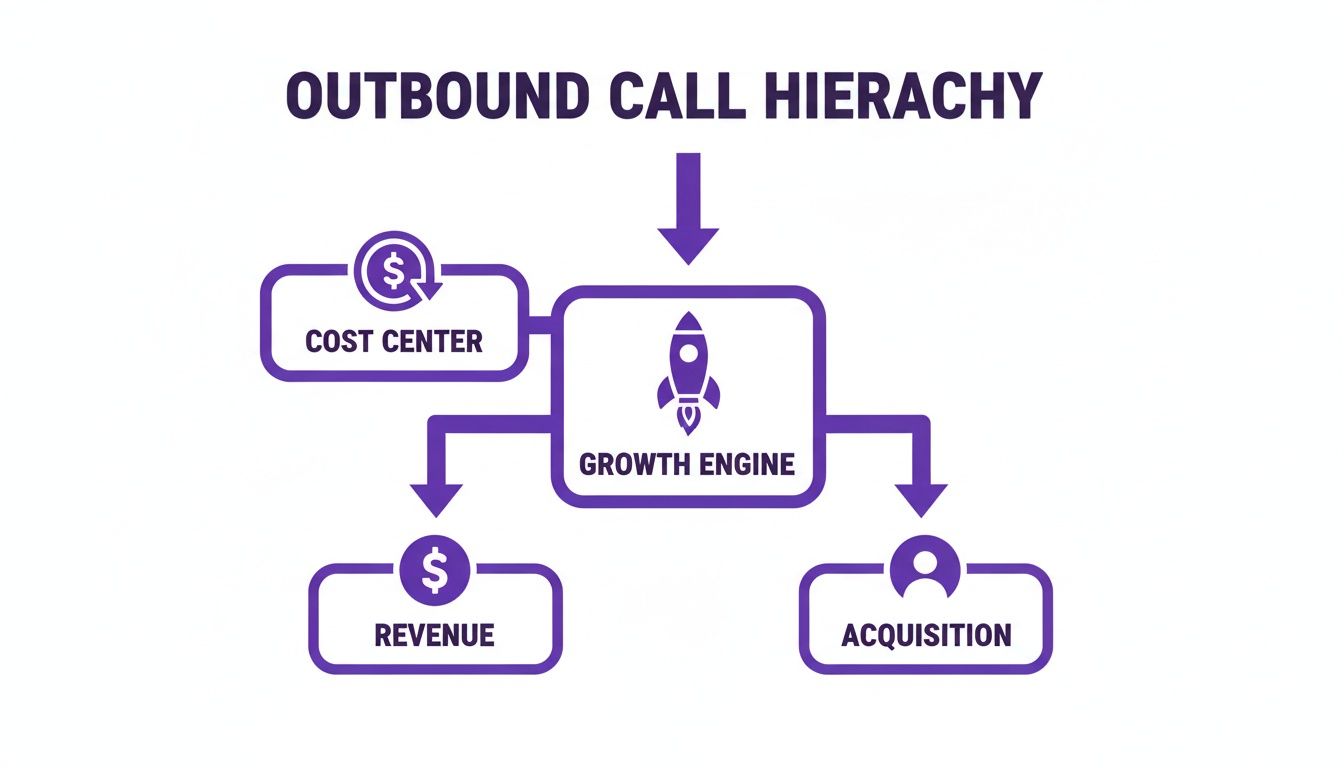
This visual shows the journey from a simple cost centre to a powerful growth machine that directly fuels revenue and brings in new customers.
The Technology Stack Powering Success
Technology is the engine of any modern outbound operation. The right tools don't just make things faster; they open up new possibilities and give you the data needed to make smart, executive-level decisions.
A solid tech stack is non-negotiable for any serious outbound effort. It usually includes:
- Customer Relationship Management (CRM) System: This is your command centre for all customer data. It tracks every touchpoint, from the first contact to the final sale, giving agents a complete picture so they can have more personal, relevant conversations.
- Intelligent Dialer: This piece of software automates the dialling process, massively increasing the number of connections an agent can make. For example, a predictive dialer, which dials multiple numbers simultaneously and only connects an agent when a live person answers, can boost an agent’s talk time from a mere 15 minutes per hour to nearly 50 minutes.
- Voice AI and Automation Platforms: Solutions like DialNexa bring AI agents into the mix. These automated agents can handle the initial outreach, qualify leads, and even schedule appointments at a scale humans simply can't match. This frees up your best agents to focus on high-value conversations that really need a human touch.
By integrating these technologies, you connect the dots between what's happening on the ground and the high-level business outcomes you care about. A better 'Conversion Rate' from an intelligent dialer directly lowers your Customer Acquisition Cost (CAC), while higher-quality leads from AI qualification can dramatically boost long-term Customer Lifetime Value (LTV).
Ultimately, this blueprint gives you a solid framework for either overhauling your current operation or building a new one from scratch. It ensures that every action taken and every rupee spent is tied to a real, measurable business impact, justifying the investment and proving the immense value of a smart outbound strategy.
Navigating Compliance and Operational Hurdles
For any senior executive, managing risk is just as crucial as chasing growth. A high-performing outbound call centre can be a fantastic engine for revenue, but it's not without its challenges. If you don't get ahead of them, these issues can seriously dent your bottom line and tarnish your brand's reputation. Think of them not as roadblocks, but as known risks you can manage with the right strategy, tools, and processes.
The two biggest headaches that hit your P&L directly are operational inefficiencies and the tangled web of legal compliance. Operational snags like high agent turnover quietly bleed money, while a single compliance mistake can lead to hefty fines and do lasting damage to your company's good name.
The Hidden Costs of Operational Drag
Inefficiency is like a slow puncture in your outbound operation – it gradually deflates profitability. The most obvious sign is often a high rate of agent attrition, a stubborn problem across the industry. When your agents are stuck doing repetitive tasks, wrestling with clunky software, and facing constant rejection, they burn out. Fast.
This kicks off a vicious and expensive cycle:
- Recruitment and Training Costs: For example, if it costs ₹50,000 to hire and train a new agent and you have a 50% annual turnover in a 100-person team, you're spending ₹25 lakhs annually just to stand still. This is capital that could be invested in growing the business.
- Loss of Expertise: Seasoned agents who know your product and your customers inside out are worth their weight in gold. When they leave, all that valuable knowledge walks out the door with them.
- Inconsistent Performance: A revolving-door team will always struggle to deliver the kind of consistent, quality conversations you need to build relationships and win business.
These issues aren't just an HR problem. They're financial liabilities that directly eat into the ROI of your entire outbound strategy.
The High Stakes of Regulatory Compliance
Looking beyond your own four walls, the external regulatory environment presents an even bigger threat. In India, the rules set by the Telecom Regulatory Authority of India (TRAI) are incredibly strict. They dictate everything from when you can call people to how you manage consent and respect Do Not Disturb (DND) registries.
A single slip-up isn't just a minor telling-off. It can result in massive fines, getting your numbers blacklisted, and causing irreversible harm to your public image. For a C-level executive, this is a huge—and entirely avoidable—business risk.
The growing use of AI in outbound calling adds another layer of complexity. As you look at automating parts of your operation, you have to get to grips with the legal and ethical side of AI-driven calls. You can learn more about the intricacies of how legal AI voices are in our detailed guide on ethics and AI phone calls. Making sure your operation is squeaky clean, whether it's run by humans or AI, is simply non-negotiable.
Strategic Solutions for a Sustainable Operation
Tackling these challenges means making a smart, proactive investment in both your people and your technology. This isn't about bloating your overheads; it's about building an outbound function that is resilient, efficient, and compliant—one that protects the business while powering its growth.
Here are a few key areas to invest in:
- Intelligent Dialling Technology: Modern diallers take the manual grind out of calling, which dramatically increases the time your agents spend actually talking to people. This is a double win for morale and productivity.
- Robust CRM Integration: A seamlessly integrated CRM gives agents the full picture on every lead, letting them have much more personal and effective conversations. This cuts down on agent frustration and bumps up conversion rates.
- Continuous Training and Development: Regularly training your team on negotiation skills, product knowledge, and the latest compliance rules makes them more confident and capable. This has a direct link to lower staff turnover and better results.
By treating these challenges as strategic priorities, you can turn your call center outbound calls from a source of risk into a sustainable, compliant, and highly profitable asset for your organisation.
The Playbook for High-Performance Outbound Teams
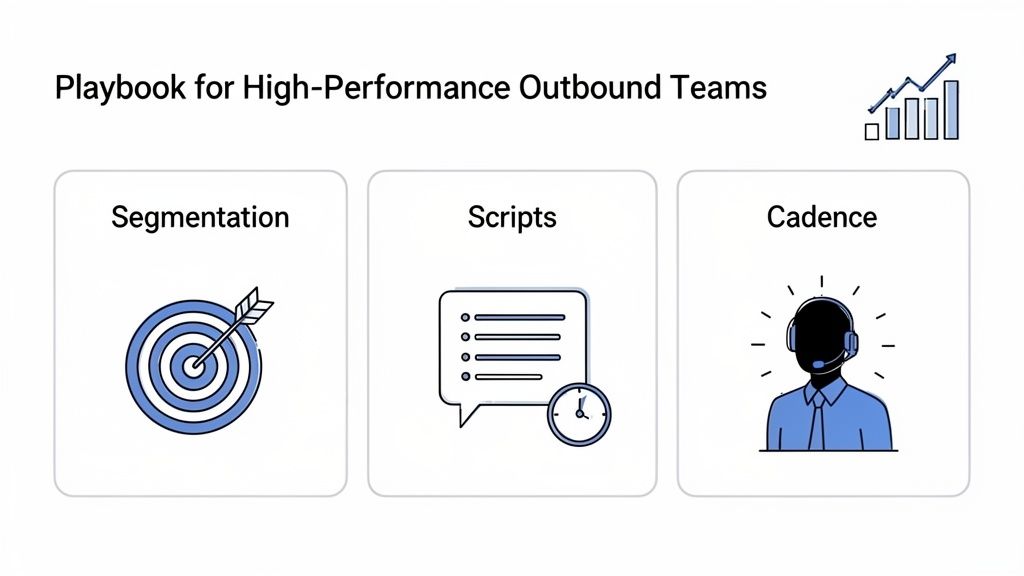
Turning an average outbound team into a genuine revenue-generating powerhouse isn't about just hiring good people. It takes a deliberate, strategic playbook that fine-tunes every single part of the outreach process. For leaders like VPs and directors, this means ditching the old "one-size-fits-all" mentality for a system built on three solid pillars: intelligent segmentation, dynamic script frameworks, and a structured call cadence.
This isn't about micromanaging your team into submission. Far from it. It's about giving them a repeatable, scalable model for success that they can rely on. When these three elements click together, you empower your agents, boost efficiency, and see a real, tangible impact on your bottom line.
Start with Smart Lead Segmentation
The absolute bedrock of any winning outbound campaign is knowing exactly who you're calling and why. Just blasting the same generic message to your entire database isn't just inefficient—it actively damages your brand's reputation. Smart segmentation is simply the practice of breaking down your leads into smaller, more focused groups based on what they have in common. This is what allows for truly personalised outreach.
Think about it like this: a real estate developer has a list of 10,000 potential buyers. The basic, lazy approach would be to call every single person with the same script. A strategic approach, on the other hand, segments that list first.
- Group A (The Budget-Conscious): These are leads who enquired about affordable 1BHK flats. Any conversation with them should immediately focus on value, EMI options, and government schemes.
- Group B (The Luxury Seekers): These are leads who downloaded brochures for the swanky penthouses. This call needs to highlight exclusive amenities, investment potential, and the prestige of the property.
- Group C (The Location-Specific): These leads only showed interest in properties in one particular neighbourhood. The agent should lead by talking about the proximity to good schools, hospitals, and transport links.
Taking this data-driven approach means the first words out of your agent's mouth are relevant and actually resonate with the prospect. It instantly shows you've done your homework and understand their needs, which dramatically increases your chances of having a productive conversation.
Build Compelling Script Frameworks
Let's be honest, the word "script" usually makes people think of robotic, inflexible monologues that agents read off a screen. That’s precisely what high-performance teams avoid. Instead of rigid scripts, they use flexible script frameworks.
These frameworks provide the essential structure and ensure all the key messages are delivered, but crucially, they also give agents the freedom to have a natural, human conversation.
A solid framework for call centre outbound calls should always include:
- A Compelling Opener: A crisp, clear introduction that grabs attention and explains the call's purpose in a way that highlights a benefit for them. Example: "Hi [Prospect Name], this is [Agent Name] from [Company]. I noticed you downloaded our guide on reducing operational costs, and I'm calling to share a specific strategy that helped a similar company in your industry save 20%."
- Key Qualifying Questions: A list of smart questions designed to uncover their specific needs, challenges, and buying intent.
- Core Value Propositions: The top 2-3 benefits of your product or service, tailored specifically to the lead's segment.
- Objection Handling Guideposts: A cheat sheet of common objections and proven responses, giving agents the confidence to navigate tricky conversations.
- A Clear Call-to-Action: The exact next step you want the prospect to take, whether that’s booking a demo, scheduling a site visit, or simply agreeing to a follow-up call.
By giving agents a framework instead of a word-for-word script, you encourage them to adapt and listen actively. This simple shift turns a monologue into a dynamic conversation, which is the only way to build real rapport and uncover genuine opportunities.
Optimise Your Call Cadence
Finally, persistence is key, but it has to be strategic. An optimised call cadence is a pre-planned sequence of outreach attempts spread over a specific period. Think of it as the sales equivalent of a marketing drip campaign, designed to maximise your chances of connection without becoming a nuisance. A good cadence maps out the timing and frequency of calls, emails, and even SMS messages.
For instance, a B2B SaaS company might roll out a 10-day cadence for a brand-new lead:
- Day 1: First call attempt in the morning, immediately followed by an introductory email.
- Day 3: Second call attempt, this time in the afternoon.
- Day 5: Third call attempt, followed by an SMS with a link to a relevant case study.
- Day 7: Fourth call attempt paired with a follow-up email that highlights a different value proposition.
- Day 10: Final call attempt before moving the lead into a long-term nurture sequence.
This kind of structured approach stops leads from slipping through the cracks and ensures everyone on the team is following up consistently. Tackling the core issues in your outreach is vital, and you can explore more about overcoming cold calling challenges with advanced AI solutions in our detailed article.
Putting a playbook like this into action gives your operations director the tools they need to immediately lift team performance, improve morale, and turn your outbound centre into a predictable, revenue-driving machine.
Unlocking Scalability With The Voice AI Revolution
As a leader, you're always looking for scalable, efficient ways to grow. For years, scaling an outbound call centre team was a straightforward but expensive formula: more agents meant more overhead, more complexity, and a linear rise in costs. Voice AI completely flips that script, turning scalability from a logistical headache into a genuine strategic advantage.
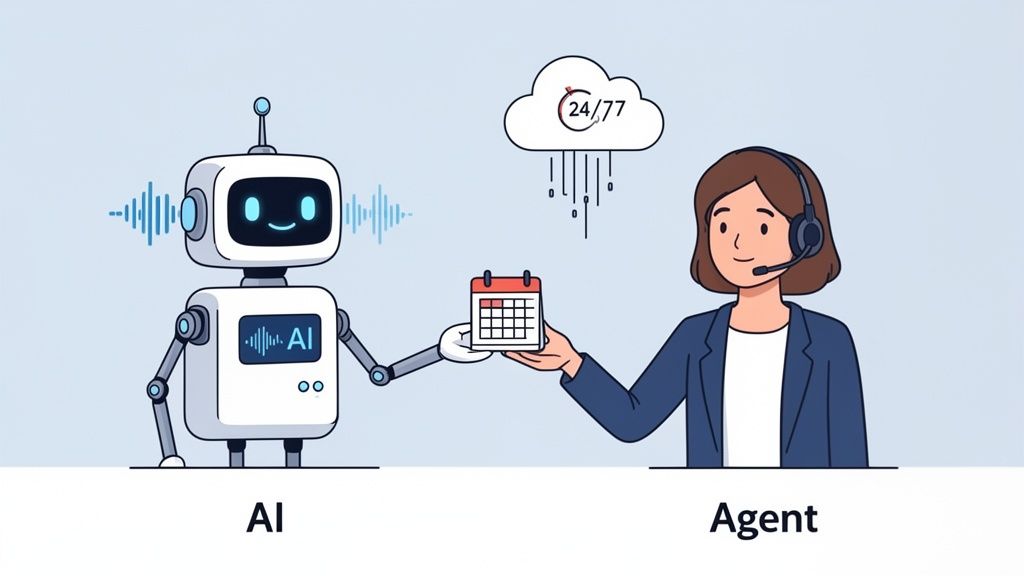
It's crucial to understand that AI agents aren't here to replace your talented people. Think of them as a powerful force multiplier instead. They're built to execute the high-volume, repetitive work that eats up an agent's day, freeing your team to focus on what humans do best: building rapport and closing complex sales.
Automating The Grind To Elevate Your Talent
Take a hard look at your current outbound process. How much of your team's day is spent on tasks that don't require strategic thinking or a personal touch? This is the "grind," and it's where AI agents shine, performing these jobs with perfect consistency every single time.
- Intelligent Dialling: The AI takes over the entire dialling process. It navigates busy signals, dodges voicemails, and skips invalid numbers without wasting a second of anyone's time.
- Initial Qualification: The AI agent kicks off a natural conversation, asking the key qualifying questions you've defined to sift serious prospects from those who are just browsing. For example, an AI could ask, "Are you the decision-maker for procurement?" or "Is your current contract up for renewal in the next six months?"
- Automated Scheduling: Once a lead checks all the boxes, the AI can jump right into their calendar, book a meeting or site visit, and send out all the confirmations automatically.
The result? Your human agents walk in to a calendar already packed with pre-qualified, high-intent appointments. They get to spend their entire day on conversations that generate revenue, not the tedious legwork of finding them. This shift boosts morale, cuts down on agent churn, and delivers a massive lift in team productivity.
Building The Business Case For Voice AI
For any executive, investing in new technology always comes down to the numbers. The business case for Voice AI in your outbound operations is solid, directly hitting on the core concerns of any C-suite: efficiency, growth, and ROI.
We're not talking about the clunky, robotic IVR systems of the past. Today's AI can hold natural, multi-minute conversations, understand nuanced questions, and carry out complex tasks. This level of sophistication produces tangible improvements in your most important KPIs.
Voice AI transforms the economics of outreach. It allows you to make thousands of consistent, compliant, and data-rich calls per day without the burnout, variability, and high costs associated with a purely human-led model.
This is especially relevant in fast-growing markets. Take India's call centre outsourcing industry, for example. It's projected to grow at a 15.9% CAGR from 2025 to 2030, a surge largely powered by AI adoption in sectors like EdTech and BFSI. AI-hybrid models are already proving their worth; platforms like DialNexa have shown AI agents hitting 91% connect rates and an 8% lead-to-booking uplift—a significant jump over traditional methods. You can learn more about these developments by reading up on India's contact centre trends on V3OS.
To put this into perspective, let's compare the two approaches side-by-side.
Human Agent vs. Voice AI Agent: A Comparative Analysis
This table breaks down how traditional human-led outbound calls stack up against a Voice AI-powered approach across the metrics that matter most to business leaders.
| Attribute | Traditional Human Agent | Voice AI Agent (e.g., DialNexa) |
|---|---|---|
| Cost Per Call | High (salaries, benefits, overhead) | Low (fractional cost, pay-per-use model) |
| Scalability | Slow & Linear (hiring, training, onboarding) | Instant (deploy hundreds of agents in minutes) |
| Operating Hours | Limited to standard work shifts | 24/7/365 (operates across all time zones) |
| Consistency | Variable (performance fluctuates with mood, fatigue) | 100% Consistent (perfect script adherence every time) |
| Compliance | Risk of human error and deviation | Flawless (follows all regulatory rules without fail) |
| Data Capture | Manual notes, often incomplete or inconsistent | Comprehensive (every detail of the call is captured & analysed) |
| Speed to Launch | Weeks or Months (recruitment, setup, training) | Days or Hours (configure campaigns and go live) |
As you can see, while human agents bring irreplaceable skills in empathy and complex negotiation, Voice AI offers unparalleled advantages in efficiency, consistency, and the ability to scale on demand.
The Strategic Advantages Beyond Cost Savings
While the efficiency gains are the first thing most people notice, the real value of Voice AI for a CXO is strategic. It’s about building an outbound engine that isn't just cheaper to run, but is also smarter, more resilient, and ready to scale at a moment's notice.
- Massive Scalability: Need to triple your outreach for a new product launch? You can spin up thousands of AI calls instantly, without a single job posting.
- 24/7 Operation: Your AI team works around the clock, engaging leads in their local time zone and connecting with them the moment their interest is piqued.
- Flawless Compliance: In regulated industries, this is huge. AI agents follow scripts and legal disclosures to the letter on every single call, virtually eliminating the risk of costly human error.
- Rich Data Collection: Every single interaction becomes a data point. The AI captures and analyses everything, giving you incredible business intelligence on script performance, common objections, and market sentiment.
When you bring Voice AI into your operations, you’re not just optimising a single process. You're building a smarter, more agile growth engine that can give you a sustainable edge over the competition.
Measuring Success and Calculating Your Outbound ROI
At the end of the day, any big decision lands on one simple question from the leadership team: what’s the return on this investment? Turning your call centre outbound calls from a necessary expense into a source of growth is no different. The real value isn't buried in call logs or talk time; it’s found in a clear, numbers-driven Return on Investment (ROI).
For senior leaders, this means looking past the obvious metrics. It’s about piecing together a complete financial story that shows where you’re saving money, where you’re making more, and what strategic ground you’re gaining. This is how you build a rock-solid case for investing in new approaches, especially with something like Voice AI.
The True ROI Calculation Framework
A proper ROI calculation is more than just subtracting expenses from revenue. To get the full picture, you have to account for all the ways an investment impacts your entire operation.
Think of it in three main parts:
- Reduced Operational Costs: This is the most straightforward win. You'll see savings from lower agent salaries as AI handles the initial outreach, less money spent on recruitment and training thanks to lower staff turnover, and even reduced infrastructure costs.
- Increased Revenue Generation: This is where you measure the impact on your top line. We're talking about higher lead conversion rates, more qualified appointments getting booked, and a noticeable shortening of your sales cycle.
- Strategic and Intangible Gains: Some of the most valuable benefits aren't easily captured on a spreadsheet, but they are crucial. This includes getting new campaigns out the door faster, gathering much cleaner data for business intelligence, and ensuring your brand message is consistent on every single call.
By looking at all three of these pillars, you stop thinking in terms of simple expenses and start building a strategic financial model. This model proves that an AI-driven outbound strategy isn't just about cutting costs—it's about building a more efficient and profitable engine for your business.
A Practical Case Study: Before and After
Let's make this real with an example. Imagine an EdTech company that has 20 human agents making calls to prospective students.
Before Voice AI:
- Operational Cost: ₹10,00,000 per month, covering salaries and all the associated overheads.
- Leads Contacted: They manage to reach 40,000 prospects a month, which works out to 2,000 per agent.
- Qualified Appointments Booked: Out of those calls, they book 800 appointments, giving them a 2% conversion rate.
- Cost Per Appointment: A hefty ₹1,250.
Now, this company brings in a Voice AI solution to handle the first-touch qualification calls. Only the genuinely interested leads are passed on to the human team.
After Voice AI:
- Operational Cost: The human agents are now focused purely on closing deals. The AI's cost is a small fraction of what they were paying in salaries, dropping their total monthly cost to ₹7,00,000—a 30% saving.
- Leads Contacted: The AI doesn't get tired. It scales up to contact 1,20,000 leads every month.
- Qualified Appointments Booked: With the AI consistently qualifying leads and the human team working with much warmer prospects, they now book 2,400 appointments. The conversion rate holds at 2%, but it’s on a much, much larger pool of leads.
- Cost Per Appointment: This plummets to just ₹292, a staggering 76% reduction.
The financial turnaround is immediate and powerful. The company didn't just triple its number of qualified appointments; it did so while slashing its operational costs. This is the kind of clear, compelling data that gets a 'yes' for strategic change.
Knowing how to track these results is everything. For a more detailed look, check out our guide on how to measure the success of your outbound campaigns with our AI voice agent.
Frequently Asked Questions
Thinking about a major change in your outbound strategy always brings up some tough questions. Here are some straight answers to the things we often hear from VPs, Directors, and other leaders when they're looking at bringing AI into their call centre outbound calls.
How Quickly Can We Actually Get Voice AI Up and Running?
One of the biggest myths is that bringing in Voice AI is a massive, months-long project. That might have been true years ago, but today's platforms are built to get you started fast.
For most companies, we can get a pilot programme live in just a few days. This lets you test out your scripts and see how the AI performs on a smaller, controlled scale. For example, a 5-day pilot could target 10,000 leads to validate connect rates and script effectiveness. From there, rolling it out across your entire operation usually takes less than a month, really just depending on how complex your campaigns and CRM hookups are.
What Happens to Our Agents When AI Comes In?
This is a big one, and it's important. Bringing in Voice AI isn't about replacing your team; it's about making them better. The AI is designed to take over the grunt work—the endless dialling, the basic qualification questions—that honestly burns out your best people.
This move frees up your skilled agents to do what they were hired for: handle conversations with genuinely interested leads. They get to focus on the high-value stuff where their empathy, problem-solving, and closing skills actually matter. You're basically turning them from call operators into expert closers, which almost always boosts morale and cuts down on agent turnover.
The whole idea is to build a team where AI handles the volume and your agents handle the value. It’s about letting your best people focus on building relationships and closing deals—the things that truly drive revenue.
How Can We Trust a Third-Party AI With Our Customer Data?
Data security is paramount. It’s a completely fair question for any leader to ask. Any credible Voice AI platform is built from the ground up with serious, enterprise-level security in mind. This means everything, including all call data, is protected with end-to-end encryption, whether it's being transmitted or just sitting on a server.
On top of that, top-tier platforms are designed to comply with strict data privacy laws like GDPR and other local regulations. Before you sign anything, you should always ask for a provider's compliance certificates and review their security measures to make sure they're up to your company's standards.
Ready to see how Voice AI could reshape your outbound strategy? See how DialNexa helps teams have more conversations and grow faster by visiting our website: https://dialnexa.com.

Leave a Reply