
10 Critical Customer Service Representative Skills for 2025
In today's competitive market, the role of a customer service representative has transformed from a support function into a crucial revenue-generating engine. For CXOs, VPs, and Directors, this paradigm shift means that traditionally 'soft' skills are now hard, measurable metrics directly impacting your bottom line. Investing in the right customer service representative skills is no longer just about managing complaints; it's a strategic imperative for improving customer retention, boosting conversions, and building a resilient brand reputation.
This article moves beyond generic advice to provide a strategic blueprint for the ten most essential skills your team needs to master. We will dissect each skill with practical, industry-specific examples relevant to sectors like BFSI, EdTech, e-commerce, real estate, and aviation. You will find actionable insights, including measurable indicators, sample interview questions, and training plans to cultivate these capabilities within your organisation.
Furthermore, we will explore how advanced technology, such as Voice AI, can augment human capabilities, standardise excellence across your team, and deliver tangible business outcomes. This guide is designed for leaders focused on building a customer service function that not only satisfies customers but actively contributes to organisational growth and profitability. Consider this your roadmap to transforming customer interactions into a powerful competitive advantage.
1. Active Listening and Comprehension
Active listening is more than just hearing words; it's about fully concentrating on, understanding, responding to, and then remembering what is being said. For a customer service representative, this skill is foundational. It involves deciphering not just the explicit request but also the implicit needs and emotional state of the customer. Misunderstanding a customer’s core issue leads directly to incorrect solutions, frustrating transfers, and a significant drop in first-call resolution rates, ultimately damaging customer loyalty and brand reputation.

This principle extends directly to AI-powered voice agents. An advanced system like DialNexa doesn't just transcribe speech; it comprehends intent and context. By analysing conversational cues, tone, and specific phrasing, it can gauge urgency and sentiment. For a deeper understanding of this technology, explore how sentiment analysis is revolutionising voice interactions. This ability to truly listen is a critical customer service representative skill, whether performed by a human or AI.
Real-World Application and Benefits
Effective listening translates directly to operational efficiency and improved customer experience across industries.
- Healthcare: An AI booking system distinguishes between a routine appointment request ("I need to book a check-up") and a patient describing urgent symptoms ("I've had a sharp pain in my chest for an hour"), prioritising and escalating the call to a human professional immediately. This reduces clinical risk and improves patient outcomes.
- EdTech: A prospective student vaguely mentions being "worried about financing." An adept human or AI agent identifies this as a query about financial aid or scholarships, routing them to a specialist counsellor instead of a generic FAQ page, thus increasing the likelihood of enrolment.
- BFSI: When a customer mentions, "I don't recognise this charge," the system correctly interprets this not as a simple billing query but as a high-priority, potential fraud case, bypassing standard IVR menus to connect them directly to the security department.
Actionable Plan for Implementation
To cultivate superior listening and comprehension skills within your team and automated systems, focus on structured analysis and refinement.
- Implement Confidence Scoring: For AI agents, set a threshold (e.g., 85% confidence). If the AI's interpretation falls below this, it should trigger a clarifying question ("Just to confirm, are you asking about your account balance?") or escalate to a human agent.
- Conduct Transcript Reviews: Regularly analyse call transcripts (both human and AI) to identify common points of misunderstanding or recurring unrecognised phrases. Use these insights to refine scripts and update the AI’s natural language processing (NLP) model.
- Train for Industry Nuances: Your training must include industry-specific jargon. A real estate agent needs to understand "stamp duty," while a BFSI representative must know what "KYC compliance" entails. This specialised vocabulary should be a core part of your AI's knowledge base.
2. Empathy and Emotional Intelligence
Empathy is the capacity to understand and share a customer's feelings, while emotional intelligence is the ability to manage and leverage those emotions effectively. For a customer service representative, these skills are paramount for de-escalating tense situations and building genuine rapport. It's the difference between a robotic, script-bound interaction and a conversation that makes the customer feel heard and valued. Lacking empathy leads to frustrated customers, negative reviews, and ultimately, customer churn, directly impacting revenue and brand loyalty.

This human-centric skill is now being engineered into advanced AI. A sophisticated voice agent like DialNexa doesn't just process requests; it gauges emotional states by analysing prosody (pitch, rhythm, and intensity) in a customer's voice. When it detects frustration or disappointment, it can adapt its tone, pace, and messaging to be more reassuring and supportive. This capability to recognise and respond to emotion is a critical customer service representative skill that elevates automated interactions from functional to exceptional, significantly enhancing the customer experience.
Real-World Application and Benefits
Applying emotional intelligence transforms customer interactions from transactional to relational, driving loyalty and satisfaction across sectors.
- E-commerce: An AI system detects rising frustration in a customer’s voice regarding a delayed shipment. It immediately shifts from a neutral to an apologetic tone: "I can hear how frustrating this delay is, and I sincerely apologise. Let me fix this for you." It then proactively offers a discount on their next purchase.
- Real Estate: When a prospective buyer expresses disappointment over a property being off the market, an empathetic agent (human or AI) acknowledges their feelings ("I understand that's disappointing news, especially when you've set your sights on a place") before suggesting similar, available listings.
- Healthcare: A patient booking an appointment sounds anxious. The system responds with a calmer, slower-paced voice, providing clear, step-by-step instructions ("Don't worry, I'll guide you through this. First, let's find a time that works for you.") and reassurance to ease their stress.
- EdTech: A student calls to express stress about an upcoming exam. An emotionally intelligent system can recognise the anxiety in their voice and respond, "It sounds like you're under a lot of pressure. I can connect you with resources to help, including a link to book time with a student support counsellor."
Actionable Plan for Implementation
To infuse your customer service with greater empathy, whether human-led or AI-powered, focus on systematic development and technological integration.
- Develop Persona-Based Responses: Create response libraries for your AI that are tailored to different emotional states. A "frustrated" persona might trigger more apologetic and solution-focused language, while an "anxious" persona receives more reassuring and patient responses.
- Utilise Prosody Analysis: For AI voice agents, leverage prosody analysis to detect real-time emotional shifts during a call. This allows the system to dynamically adjust its approach, rather than following a rigid script.
- Conduct Empathy Training: For human agents, use role-playing scenarios focused on difficult customer conversations. Analyse call recordings to provide specific feedback on where empathy could have been demonstrated more effectively.
- A/B Test Emotional Messaging: Test different empathetic phrases and tones within your AI's conversational flows. Analyse which variations lead to higher customer satisfaction scores (CSAT) and better call outcomes to continuously refine your strategy.
3. Product and Service Knowledge
A customer service representative without deep product knowledge is like a library with no books: the structure is there, but the core value is missing. This foundational skill involves a thorough understanding of your company’s offerings, including features, pricing, terms of service, and competitive positioning. For representatives, both human and AI, this knowledge is what transforms a simple Q&A session into a consultative experience, enabling them to provide accurate information, troubleshoot effectively, and make confident recommendations. Inaccurate or incomplete information erodes customer trust and can lead directly to lost sales and increased churn.
This principle is mission-critical for AI voice agents designed to handle substantive interactions. An advanced system like DialNexa must be trained on a comprehensive knowledge base, allowing it to function as a product specialist. It needs to understand industry-specific details, from real estate property specifications to complex financial instruments, to qualify leads and resolve queries without human intervention. To see how AI can manage complex information, explore our insights on how conversational AI can automate lead qualification. This command of product details is a non-negotiable customer service representative skill.
Real-World Application and Benefits
Expert product knowledge directly translates to higher resolution rates, increased sales conversion, and superior customer satisfaction.
- Real Estate: A prospective buyer asks, "Does this property have Vastu compliance?" An AI agent with deep knowledge can instantly confirm this detail and provide specifics about the direction of the entrance, then schedule a viewing.
- E-commerce: An AI-powered agent can confirm inventory levels for a specific product variant (e.g., "the blue shirt in size large"), explain the 30-day return policy, and clarify that shipping to the customer's PIN code will take 2-3 business days.
- BFSI: When a client enquires about a specific mutual fund, an AI agent can provide its 5-year CAGR, expense ratio, and risk profile, and explain the KYC process required for investment, demonstrating expertise and building investor confidence.
Actionable Plan for Implementation
To build and maintain robust product and service knowledge, focus on centralisation, structure, and continuous improvement.
- Integrate a Central Knowledge Base: Connect your AI platform directly to your CRM and product management systems. This ensures the AI agent always has real-time, accurate information on everything from stock levels to service updates.
- Structure Knowledge Hierarchically: Organise information into tiers (e.g., basic features, advanced use cases, technical specifications). This allows the AI to provide contextually appropriate answers without overwhelming the customer.
- Schedule Regular Knowledge Audits: Periodically review the AI's interaction logs to identify recurring questions it cannot answer. Use these insights as a roadmap to fill gaps in its knowledge base and training data.
- Implement Fallback Protocols: For edge-case queries outside its core training, program the AI to use phrases like, "That's a very specific question, let me connect you with a specialist who has the exact details," before escalating to a human agent.
4. Communication Clarity and Articulation
Clear communication is the bridge between a customer's problem and its solution. It involves expressing information concisely, logically, and in a language the customer can easily understand, eliminating ambiguity and confusion. For a customer service representative, this skill is paramount, as unclear explanations lead to repeat calls, customer frustration, and a breakdown in trust. Ineffective communication can turn a simple query into a complex complaint, directly impacting operational costs and brand perception.
This principle is even more critical for AI voice agents. A system like DialNexa must do more than just recite information; it must articulate it with clarity. This involves using proper pronunciation, adopting an appropriate vocabulary level, and organising information logically. An AI that uses confusing jargon or a convoluted sentence structure will fail to serve the customer effectively. For a deeper dive into this, see how advancements in conversation design are shaping AI interactions. Superior articulation is a non-negotiable customer service representative skill, regardless of whether the agent is human or AI.
Real-World Application and Benefits
Clarity in communication delivers tangible benefits by ensuring customers feel informed and confident, which accelerates resolution times and enhances satisfaction.
- BFSI: Instead of saying, "You must complete the mandated KYC process," an AI agent explains, "To protect your account, we need to verify your identity. This involves submitting a PAN and Aadhaar card, which you can do directly through our app in three simple steps." This clear, action-oriented language improves compliance rates.
- Healthcare: Automated booking systems can provide clear pre-appointment instructions, such as, "Please remember not to eat or drink anything for eight hours before your 9 AM appointment on Tuesday," reducing missed appointments and improving patient preparedness.
- EdTech: A voice system can break down a complex course structure or fee schedule into digestible parts—"The total fee is ₹50,000, payable in two instalments of ₹25,000 each"—helping prospective students make informed decisions without needing human intervention.
Actionable Plan for Implementation
To embed clarity and articulation into your customer service operations, focus on systematic design and continuous testing.
- Use Short, Concise Sentences: For voice-based communication, script responses using short sentences, ideally 10-15 words maximum. This makes information easier for listeners to process and retain.
- Conduct Readability Testing: Analyse your scripts and knowledge base articles using tools like the Flesch-Kincaid readability tests. Aim for a score that aligns with a general audience to ensure broad comprehension.
- Implement Strategic Pausing: Programme AI agents to pause strategically after delivering key pieces of information (e.g., an account number or a transaction total). This gives the customer a moment to absorb the details before the conversation moves on.
5. Problem-Solving and Troubleshooting
Beyond simply answering questions, a core customer service representative skill is the capacity to diagnose issues, think critically about solutions, and guide customers toward resolution. This involves deconstructing a problem to identify its root cause, not just addressing the surface-level symptom. For representatives, strong problem-solving reduces escalations, decreases repeat calls, and significantly boosts customer satisfaction by providing tangible, effective solutions quickly and competently.
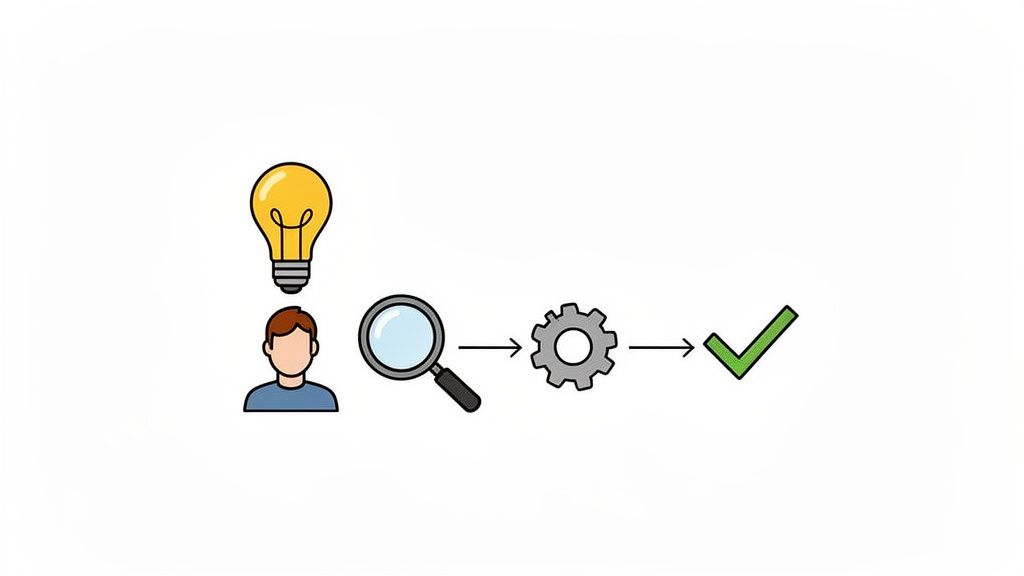
An AI-driven system can excel here by using logical reasoning to navigate complex scenarios. For instance, a sophisticated voice agent like DialNexa can be programmed with diagnostic decision trees to ask targeted questions, systematically narrowing down possibilities until the core issue is identified. It can then provide step-by-step guidance, standardising the troubleshooting process for common issues and ensuring consistent, accurate support 24/7, freeing human agents for more intricate cases.
Real-World Application and Benefits
Effective troubleshooting is a direct driver of operational efficiency and customer retention across diverse sectors.
- EdTech: When a student reports, "I can't access my course," an agent (human or AI) troubleshoots by asking, "Are you using Chrome or another browser? Have you cleared your cache recently?" This identifies the problem as browser incompatibility and provides a specific solution instead of a generic "try again" response.
- BFSI: An agent assists a customer with a failed online transaction by asking, "Did you receive a one-time password (OTP)? Is your debit card enabled for international transactions?" This identifies a card setting issue and provides clear instructions on how to rectify it through their banking app.
- E-commerce: A customer reports a missing delivery. The agent diagnoses the issue by checking tracking information, identifying it's marked "out for delivery," and then asks, "Could you confirm your flat number is 4B? Sometimes the address gets truncated." This identifies and corrects a simple data error, resolving the issue.
Actionable Plan for Implementation
To build a robust problem-solving framework, focus on creating structured, repeatable processes for both your team and your technology.
- Develop Decision Trees: Map out common customer issues and their corresponding solutions in a clear, logical flowchart. This becomes a powerful knowledge base for human agents and a direct script for AI troubleshooting protocols.
- Use Progressive Disclosure: Train agents and program AI to ask only the most essential diagnostic questions first. Avoid overwhelming the customer with a long list of queries, revealing more specific questions only as needed based on their initial answers.
- Provide Numbered Steps: When guiding a customer through a fix, always provide clear, numbered steps. This structured approach is easier to follow and confirms progress, reducing customer confusion and frustration.
- Set Clear Expectations: Begin troubleshooting by stating the likely duration ("Let's try a few steps, this should take about five minutes"). This manages customer expectations and builds trust in the process.
6. Lead Qualification and Needs Assessment
Lead qualification is the strategic process of evaluating a prospect's potential to become a customer. For a customer service representative, this skill involves asking targeted questions to determine a customer's fit, understand their specific needs, and identify genuine sales opportunities. Failing to qualify leads effectively means wasting valuable time on low-intent prospects, which inflates customer acquisition costs and diverts resources from high-potential opportunities, ultimately hindering revenue growth.
This function is a core value proposition for AI-powered agents. A sophisticated system like DialNexa excels at this by distinguishing serious buyers from casual browsers through conversational analysis. It can systematically gather critical information, assess decision-making criteria, and segment leads based on their conversion potential. The ability to perform a consistent and accurate needs assessment is a crucial customer service representative skill that directly impacts the sales pipeline.
Real-World Application and Benefits
Effective lead qualification streamlines the sales process and ensures that high-value prospects receive the attention they need, maximising conversion rates across diverse sectors.
- Real Estate: An AI agent qualifies a property enquiry by asking about budget range ("Are you looking for properties under ₹1 Crore or above?"), preferred location, timeline for purchase ("Are you looking to move in the next 3 months?"), and decision-making authority, instantly routing pre-approved, high-intent buyers to a senior property consultant.
- EdTech: A system assesses a prospective student's needs by asking about their career goals, preferred mode of study (full-time vs. part-time), and if they have the required prerequisite qualifications, connecting them with the most relevant admissions counsellor.
- E-commerce: A representative or bot identifies a high-intent customer looking at bulk products by asking, "Is this purchase for personal use or for a business?" This allows them to route the lead to the B2B sales team for preferential pricing, closing a larger deal.
Actionable Plan for Implementation
To build a robust lead qualification framework, focus on creating structured criteria and leveraging data to refine the process continuously.
- Develop a Qualification Rubric: Create an industry-specific scoring model with weighted criteria. For example, in BFSI, a prospect with high investment capital and previous trading experience would receive a higher score and be prioritised for a follow-up call.
- Use Qualifying Questions Early: Train human and AI agents to ask critical qualifying questions at the beginning of the interaction to avoid prolonged conversations with unqualified leads. This respects the time of both the representative and the customer.
- Track and Adjust Criteria: Monitor qualification accuracy by comparing initial lead scores against final conversion outcomes. Use this sales pipeline analysis to regularly adjust and refine your qualification criteria for better predictive accuracy.
7. Call Handling and Conversation Flow Management
Excellent call handling is the art of structuring conversations logically to guide a customer efficiently from their initial query to a successful resolution. This customer service representative skill involves more than just talking; it's about architecting the interaction. It includes setting the context with a strong opening, progressing through topics in a clear sequence, managing interruptions gracefully, and concluding with definitive next steps. Inefficient flow leads to longer call times, customer confusion, and a failure to achieve the call's primary objective, ultimately increasing operational costs and customer churn.
AI agents are designed with conversation flow management at their core. A system like DialNexa can be programmed with specific, goal-oriented conversational pathways that ensure consistency and efficiency in every interaction. These agents use predefined logic to navigate complex queries, ensuring no critical step is missed while adapting to customer responses. To see how this structure is powered in real-time, you can explore how AI agent assist transforms customer interactions. This systematic approach is a key customer service representative skill that guarantees a predictable and positive experience.
Real-World Application and Benefits
A well-managed conversation flow creates a seamless customer journey and delivers measurable business outcomes.
- Real Estate: An AI agent follows a precise discovery ("What are you looking for?") → property recommendation ("Based on that, I have three properties for you.") → site-visit booking ("Would you like to schedule a visit for Saturday?") flow, ensuring every lead is qualified and moved to the next stage without manual intervention.
- BFSI: A support agent manages a structured KYC guidance → document submission check → account activation confirmation sequence, ensuring full compliance and reducing account setup delays.
- Healthcare: An automated system handles a symptom check → appointment availability check → booking confirmation workflow, freeing up staff to handle more complex patient needs.
Actionable Plan for Implementation
To implement and optimise conversation flow management, focus on designing, testing, and refining your interaction blueprints.
- Design Conversation Blueprints: For your most common query types, map out the ideal conversation flow with clear stages, decision points, and potential detours. Define the entry and exit criteria for each stage.
- Use Time Markers: Train human and AI agents to manage customer expectations by using verbal cues like, "I just need to ask you three quick questions to verify your account," to signal the conversation's length and structure.
- Build Flexible Fallbacks: While structure is crucial, conversations can be unpredictable. Create and script fallback responses for common tangents or unexpected requests to gracefully redirect the customer back to the main flow without causing frustration.
8. Objection Handling and Persuasion
Objection handling is the skill of addressing customer concerns and hesitations with empathy and evidence to guide them toward a satisfactory resolution. It is a nuanced blend of active listening, product expertise, and strategic communication. For a customer service representative, mastering this skill transforms potential roadblocks into opportunities for building trust and reinforcing the value of your offering. Failing to handle objections effectively can halt a sales process, escalate a minor complaint into a major issue, and ultimately lead to customer churn.
This skill is crucial not just for human agents but also for sophisticated AI. A system like DialNexa can be programmed to recognise common objections through keyword and sentiment analysis. For instance, upon detecting phrases like "it's too expensive" or "I'm not sure," it can present pre-approved, data-backed counterpoints or offer to connect the customer to a specialist for a more detailed discussion. This automated first-line defence is a vital customer service representative skill in a modern, scalable support model.
Real-World Application and Benefits
Effective objection handling directly impacts conversion rates and customer satisfaction, preventing revenue loss and strengthening relationships.
- Real estate: When a prospect states, "The price is too high," an adept agent or AI system can counter with, "I understand. However, similar properties in this locality have appreciated by 15% in the last year. This isn't just a home; it's a strong investment." It could also offer alternative financing options.
- EdTech: A potential student expressing, "I don't have enough time for this course," can be shown flexible learning paths: "Many of our students are working professionals. Our weekend-only batch might be a perfect fit. It requires just 8 hours per week."
- E-commerce: For a customer who says, "I found a similar product cheaper elsewhere," a representative can respond, "That's a fair point. Our product includes a 2-year warranty and dedicated customer support, which offers greater long-term value and peace of mind."
- BFSI: When a client voices concerns like, "The market is too volatile for an investment now," a well-trained representative can explain, "That's a valid concern. That's why many of our clients are opting for a Systematic Investment Plan (SIP) to average out the cost and mitigate risk."
Actionable Plan for Implementation
To build a robust objection handling framework for both human and AI agents, focus on preparation, technique, and continuous learning.
- Develop an Objection Map: Proactively identify the top 5-10 objections in your industry. For each, create a library of evidence-based, compliant responses and empower your team and AI with this knowledge base.
- Train the 'Feel-Felt-Found' Technique: Coach representatives to use this three-step method: Acknowledge the customer's feeling ("I understand you feel the price is high"), validate it by sharing how others felt the same ("Many clients have felt that way initially"), and then explain what they found ("However, they found that the long-term energy savings offset the cost within three years").
- Use Clarifying Questions: Instead of jumping to a defence, train your system and team to ask probing questions like, "Could you help me understand what specific aspect of the timing concerns you?" This reveals the true root of the objection, allowing for a more precise solution.
9. Data Entry Accuracy and CRM Management
Flawless data entry and meticulous Customer Relationship Management (CRM) are the operational backbone of customer service. This skill involves accurately capturing customer information, inputting data into systems without error, and maintaining organised records for follow-up and historical context. For a customer service representative, even a small mistake, like a typo in an email address or an incorrect query tag, can lead to failed follow-ups, irrelevant marketing, and a fragmented customer journey. This erodes trust and creates significant downstream inefficiencies.
This administrative rigour is equally critical for AI agents. An advanced voice AI like DialNexa must do more than just understand a conversation; it needs to accurately parse, structure, and log key data points directly into your CRM. This ensures that every interaction enriches the customer profile, providing valuable intelligence for sales, support, and marketing teams. The ability to maintain data integrity is a non-negotiable customer service representative skill that underpins personalisation and operational excellence.
Real-World Application and Benefits
Accurate, automated data management creates a single source of truth, enabling proactive and personalised service across various sectors.
- BFSI: A voice agent correctly logs a prospect's stated investment experience as "beginner" and risk tolerance as "low," ensuring they are routed to an advisor specialising in low-risk mutual funds and receive compliant product information.
- Real Estate: An AI captures a caller's property preferences (3 BHK, budget ₹1.5 Cr, near a metro station), automatically creating a detailed lead profile in the CRM that agents can act on immediately, without needing to ask repetitive questions.
- Healthcare: A system accurately documents a patient's contact details, appointment preferences, and insurance provider ID, preventing administrative errors that could lead to billing issues or missed appointment reminders.
Actionable Plan for Implementation
To build a culture of data accuracy, leverage both human diligence and system-level checks.
- Implement Real-Time Validation: Configure your CRM and AI systems with validation rules. If an email is entered in an incorrect format or a phone number has the wrong number of digits, the system should prompt for immediate correction, preventing bad data at the source.
- Use Confirmation Techniques: Train both human agents and AI to use read-back confirmations for critical information. A simple script like, "Just to confirm, I have your policy number as XYZ123, is that correct?" significantly reduces input errors.
- Design Conversation-Aligned Schemas: Structure your CRM data entry fields to mirror the natural flow of a customer conversation. This reduces the cognitive load on agents and allows AI to map conversational data to CRM fields more logically and accurately.
10. Compliance Knowledge and Regulatory Awareness
Compliance knowledge is the understanding of legal requirements, industry regulations, data privacy laws, and company policies that govern customer interactions. For a customer service representative, particularly in regulated industries like finance and healthcare, this skill is non-negotiable. A failure to adhere to compliance protocols can lead to severe legal penalties, hefty fines, data breaches, and a catastrophic loss of customer trust, directly impacting the company's financial stability and market reputation.
This crucial customer service representative skill is equally important for AI. An advanced conversational AI like DialNexa must have compliance logic embedded into its core conversational flows. It's not enough to simply answer a question; the AI must verify identity before disclosing sensitive information, provide necessary disclaimers, and log interactions for audit trails. It serves as a consistent, reliable first line of defence against regulatory violations, ensuring every interaction meets legal standards.
Real-World Application and Benefits
Strict adherence to compliance frameworks is a strategic advantage that protects both the customer and the organisation.
- BFSI: A Voice AI guiding a customer through a loan application must provide mandatory disclosures like, "Please note that mutual fund investments are subject to market risks," at specific points in the conversation, ensuring compliance with SEBI guidelines.
- Healthcare: An automated appointment system must strictly adhere to HIPAA (or equivalent local data protection laws), never revealing Protected Health Information (PHI) without explicit, verified patient consent. For example, it would refuse to confirm an appointment for a caller who fails identity verification.
- EdTech: When handling student records, an agent (human or AI) must operate within the bounds of regulations like FERPA, ensuring student data privacy is maintained during inquiries about grades or enrolment status.
Actionable Plan for Implementation
To embed robust compliance awareness into your service operations, a systematic approach to training and technology is essential.
- Develop Compliance Playbooks: Create clear, scenario-based guides for common compliance-sensitive interactions, such as handling a data access request under GDPR or a complaint requiring a specific escalation path.
- Integrate Compliance Checkpoints: Program AI conversation flows with mandatory compliance gates. For instance, an AI should not proceed with an account information request until it has successfully completed a two-factor authentication or identity verification step.
- Schedule Regular Regulatory Reviews: Conduct quarterly audits of your scripts, AI knowledge bases, and operational procedures to align them with the latest changes in industry regulations (e.g., SEBI circulars, IRDAI updates) to prevent operational gaps.
Top 10 Customer Service Representative Skills Comparison
| Skill | 🔄 Implementation Complexity | Resource Requirements 💡 | ⚡ Speed / Efficiency | Ideal Use Cases | 📊 Expected Outcomes ⭐ |
|---|---|---|---|---|---|
| Active Listening and Comprehension | High — advanced NLP, sentiment & context retention | Large: speech models, noise-robust data, ongoing training | ⚡ Medium — real-time possible but compute‑intensive | Lead qualification, support routing, healthcare triage | ⭐ High accuracy (~97% match), fewer repeat calls, improved FCR |
| Empathy and Emotional Intelligence | High — prosody & emotion modelling, adaptive responses | Diverse emotion-labelled datasets, persona libraries, tuning | ⚡ Medium — real-time detection with calibration needs | Retention calls, sensitive support, patient interactions | ⭐ Higher satisfaction, lower escalations, conversion uplift (2–8%) |
| Product and Service Knowledge | Medium — KB integration and mapping to intents | CRM/product DB integration, frequent content maintenance | ⚡ High — fast information retrieval when integrated | Sales support, upsell/cross-sell, product inquiries | ⭐ Better FCR, fewer transfers, increased customer confidence |
| Communication Clarity and Articulation | Medium — TTS tuning, readability & multilingual support | High-quality TTS, readability testing, locale models | ⚡ High — concise delivery speeds decision-making | Onboarding, regulated disclosures, instructional support | ⭐ Reduced confusion, faster decisions, improved accessibility |
| Problem-Solving and Troubleshooting | High — reasoning, decision trees, escalation logic | Diagnostic flows, domain expertise, analytics for refinement | ⚡ Medium — often multi-turn but outcome-focused | Technical support, KYC issues, complex customer problems | ⭐ Lower ticket volume, improved FCR, cost reductions |
| Lead Qualification and Needs Assessment | Medium — scoring logic, multi-criterion rules | Scoring models, engagement signals, CRM scoring integration | ⚡ High — rapid scoring and prioritization | High-volume sales, appointment booking, pipeline building | ⭐ Improved conversion (2–8%), high match accuracy (~97%), better connect rates |
| Call Handling & Conversation Flow Mgmt | Medium — flow design with flexibility and fallbacks | No-code/visual builders, scripted paths, testing frameworks | ⚡ High — optimizes call time and consistency | Bookings, discovery → scheduling flows, scripted outreach | ⭐ More successful outcomes per call, reduced average duration |
| Objection Handling and Persuasion | Medium–High — pattern recognition + nuanced responses | Objection libraries, evidence templates, trained rebuttals | ⚡ Medium — timely but deliberative responses required | Sales negotiations, retention, pricing or fit objections | ⭐ Higher conversion rates, fewer repeat objections, improved trust |
| Data Entry Accuracy & CRM Management | Medium — STT quality, validation, dedupe logic | CRM integrations, validation rules, audit trails, security | ⚡ High — automates logging and reduces manual work | Lead capture, follow-up automation, omnichannel records | ⭐ Improved data quality, faster follow-ups, audit-ready records |
| Compliance Knowledge & Regulatory Awareness | High — rules by jurisdiction, auditability | Compliance frameworks, logging, legal updates, training | ⚡ Medium — cautious flows may slow interactions | BFSI, healthcare, regulated communications | ⭐ Reduced legal risk, consistent policy adherence, audit readiness |
Orchestrating CX Excellence: Your Strategic Next Steps
We have navigated the intricate landscape of essential customer service representative skills, moving beyond a simple checklist to understand each competency as a strategic pillar supporting your entire customer experience (CX) framework. From the foundational necessity of Active Listening and Empathy to the business-critical functions of Lead Qualification and Compliance Knowledge, it's clear that a modern customer service representative is far more than a problem-solver; they are a brand ambassador, a revenue enabler, and a guardian of your company's reputation.
For the C-suite and departmental leaders in sectors like BFSI, EdTech, and real estate, the core challenge is not just identifying these skills but institutionalising them. How do you ensure that every one of the thousands of daily interactions reflects the highest standards of Communication Clarity, Problem-Solving, and Data Entry Accuracy? Relying solely on manual training and inconsistent human application is a high-risk, low-reward strategy in today's competitive market.
From Individual Skills to an Organisational Competency
The true value of mastering these customer service representative skills is realised when they are woven into the very fabric of your operational strategy. This is where the synthesis of human talent and artificial intelligence becomes a game-changer. Consider the skills we’ve discussed:
- Standardisation and Compliance: Skills like Compliance Knowledge and CRM Management are non-negotiable, especially in heavily regulated industries like healthcare and finance. Human error here can lead to severe penalties. AI-powered systems can enforce these protocols automatically, flagging deviations and ensuring every interaction adheres to legal and company standards.
- Efficiency and Focus: Repetitive yet crucial tasks like initial Lead Qualification and managing Call Handling flows can be significantly optimised through automation. This frees your highly-trained human agents from mundane work, allowing them to dedicate their cognitive and emotional energy to more complex, high-value interactions that demand sophisticated Objection Handling and deep Empathy.
- Data-Driven Improvement: How do you objectively measure a skill like Active Listening or Conversation Flow Management across your entire team? AI can analyse call transcripts at scale, identifying keywords, sentiment shifts, and adherence to best practices. This provides concrete, unbiased data to guide targeted training programmes and performance reviews, turning abstract skills into measurable key performance indicators (KPIs).
A strategic insight for leaders: Your goal should not be to replace human agents, but to augment them. By automating the predictable, you empower your people to excel at the exceptional. This human-AI partnership transforms your customer service department from a cost centre into a powerful engine for customer loyalty and revenue growth.
Your Actionable Blueprint for CX Transformation
To translate the insights from this article into tangible results, your next steps should be methodical and strategic. Don't attempt to overhaul everything at once. Instead, focus on a phased approach to build a resilient, high-performing CX organisation.
- Conduct a Skills Audit: Benchmark your current team against the ten core skills outlined in this guide. Where are your strengths? More importantly, where are the critical gaps that expose your business to risk or lost opportunity?
- Identify Automation Candidates: Review your customer interaction workflows. Pinpoint the processes that are repetitive, rule-based, and have a high potential for human error. These are prime candidates for automation with a sophisticated Voice AI platform.
- Invest in Targeted Training: Use the data from your audit to create customised training modules. Instead of generic programmes, focus on developing the specific customer service representative skills that will have the most significant impact on your business objectives, whether that's improving lead conversion rates or boosting customer satisfaction scores.
- Implement and Measure: Deploy your new human-AI framework. Establish clear metrics to track its impact on efficiency, compliance, customer sentiment, and ultimately, your bottom line. Continuously refine your approach based on real-world data.
By embracing this strategic approach, you elevate the role of customer service within your organisation. It ceases to be a reactive function and becomes a proactive, data-informed cornerstone of your business strategy, directly contributing to a superior customer journey and a healthier, more profitable company.
Ready to transform your customer service operations from a cost centre into a strategic asset? Discover how the Voice AI solutions from DialNexa can help you standardise critical customer service representative skills, automate routine tasks, and empower your team to deliver exceptional experiences at scale. Visit DialNexa to see how our technology can orchestrate CX excellence for your organisation.

Excellent breakdown of how customer service skills directly influence customer trust, operational efficiency, and long-term business growth. The connection between human expertise and AI-powered support creates a compelling vision for delivering consistent, high-quality customer experiences at scale.