
AI Call Center Agent: Drive ROI in 2026
India's customer conversations already sit on a scale most companies under-estimate. TRAI recorded about 1,294 million mobile subscribers in May 2026, yet only 37.8% of calls to small businesses are answered by a live person, which means roughly 62% go unanswered and the economy absorbs about USD 55 billion per year in lost productivity from poor call and service response (India voice-agent statistics for 2026). For CXOs, that changes the conversation from “Should we try voice AI?” to “How fast can we build an AI call center agent that captures missed demand, qualifies leads, and resolves routine requests before a human ever needs to intervene?”
The strategic case is straightforward. When a business misses calls at scale, the problem is not just service quality, it's revenue leakage, slower follow-up, and avoidable operational drag. Leaders who are evaluating this space can also use a guide to agentic AI for leaders to frame the broader shift from simple automation to systems that can reason, act, and hand off cleanly.
Table of Contents
- Understanding AI Call Center Agents
- AI Call Center Agent Architecture
- Industry Use Cases and Personas
- Implementation Roadmap and Best Practices
- Key Performance Indicators and ROI Examples
- Common Pitfalls and Mitigation Strategies
- Vendor Selection and Pilot Design
- Getting Started with AI Call Center Agents
Understanding AI Call Center Agents
An AI call center agent is a software system that can listen to a caller, identify intent, respond in natural language, and trigger business actions such as booking, qualification, escalation, or record updates. That makes it closer to a digital operator than a simple chatbot. A chatbot usually answers within a narrow script, while an AI call center agent has to manage voice, timing, context, and handoffs in a live conversation.
That difference matters because call handling is a process, not a single reply. The agent needs to catch speech, interpret meaning, choose the next action, and keep the exchange moving without making the caller repeat information. When the task is straightforward, such as confirming an appointment or checking account status, the agent can complete the work on its own. When the call turns into negotiation, emotion, or a policy exception, it should route the caller to a human without losing the conversation history.
A useful way to explain the model is to compare it to a front-desk team. One person greets the caller, another checks the record, and a third updates the system. An AI call center agent compresses those steps into one interaction, which is why leaders evaluating automation often find the guide to agentic AI for leaders helpful. Agentic systems matter when the work is not just about replying, but about deciding what to do next.
The practical test is simple. If a call has a clear goal and a defined set of backend actions, the AI agent should handle it first. If the call depends on judgment, persuasion, or sensitive context, the system should pass it to a person with the full record attached.
That is why AI call centre adoption is moving beyond an IT pilot and into CXO conversations. Leaders are looking at response capacity, consistency, and the ability to turn missed calls into measurable revenue or service recovery. In that sense, the agent is not replacing the contact center. It is giving the contact center a faster first layer, so the team can spend more time where human judgment adds value.
AI Call Center Agent Architecture
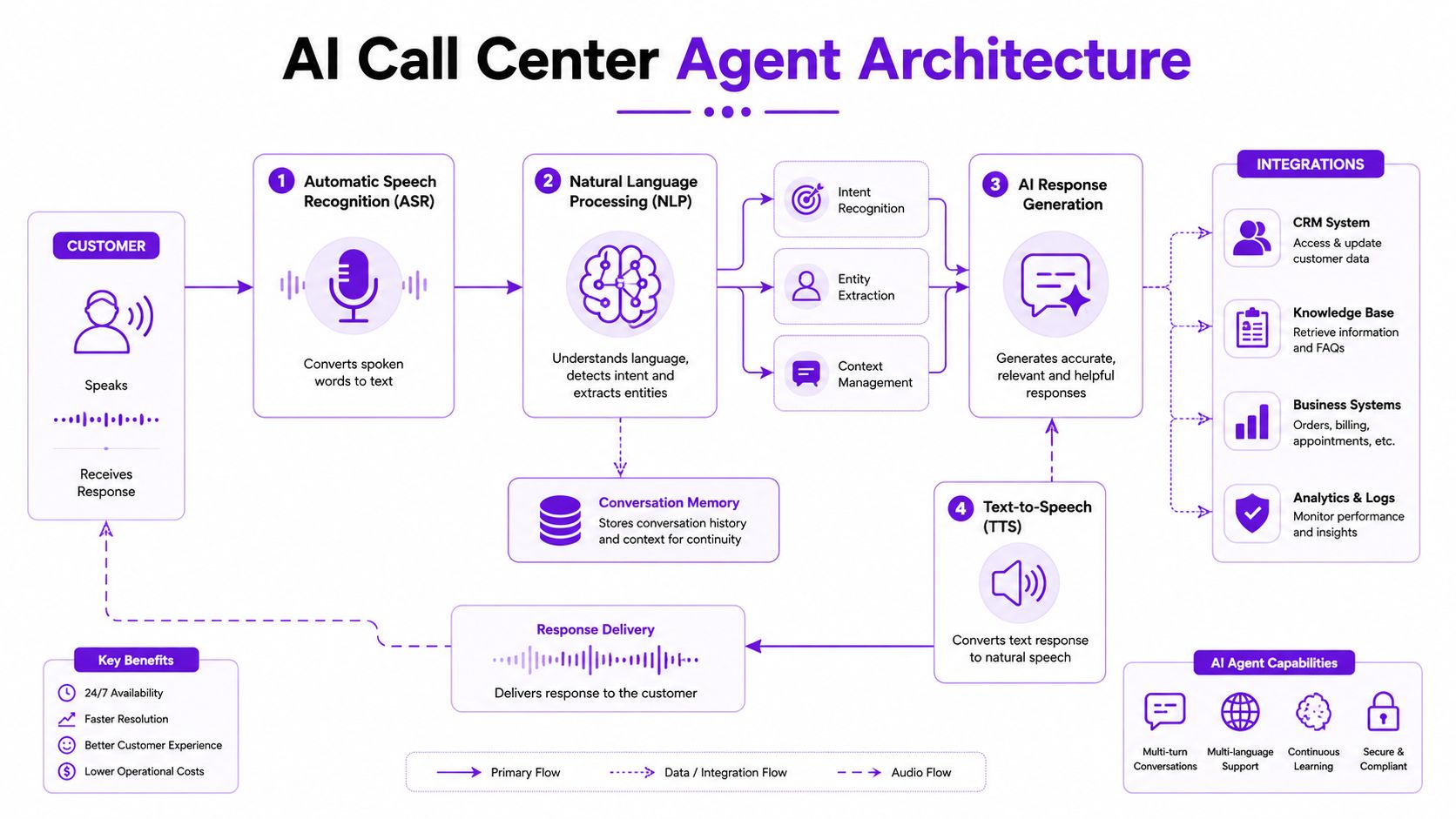
A call center AI stack works like a relay team at peak traffic. One layer hears the caller, another interprets intent, another prepares the reply, and the business systems complete the action. If one layer slows down, the whole interaction feels strained, especially at Indian call volumes where every extra pause can push callers toward abandonment.
Speech in, meaning out
Automatic Speech Recognition, or ASR, converts spoken words into text. Natural Language Processing, or NLP, reads that text to identify intent, such as a KYC question, a refund request, or an appointment booking. Text-to-Speech, or TTS then turns the response back into a natural voice. For a developer-focused breakdown of that stack, see the voice AI agents for developers guide.
Speed matters because voice calls are conversational, not batch jobs. Indian deployment guidance recommends keeping end-to-end latency under 800 ms so the agent can preserve natural turn-taking in code-mixed conversations and maintain caller trust (latency guidance for Indian deployments). That means the architecture cannot depend on a slow chain of separate tools. It needs streaming ASR, quick retrieval from CRM or knowledge bases, and cached prompts for common intents.
Systems the agent must connect to
A voice agent becomes useful only when it can act inside the enterprise stack. That usually means CRM integration, knowledge-base retrieval, and compliance tooling. A BFSI call, for example, may require identity checks, record updates, and audit trails during the same interaction, not after it. When the agent escalates, it also has to pass along the full conversation context so the human agent does not ask the caller to repeat everything.
The architecture should answer with access to policy, customer history, and the next action the business needs to take.
That idea matters for CXOs because the primary constraint is scale, not novelty. A system that handles a few polite demos can still fail when calls become noisy, interrupted, or multi-step. The design has to support real operational load, the same way a payment system has to keep working after the first successful test transaction. For teams building the underlying call flow, the guide to AI for sales development is useful because it shows how routing, qualification, and handoff logic shape business outcomes.
Why architecture choices matter
The best deployments are built for repeated operational patterns, not one-off demos. If the stack cannot support interruptions, multi-turn dialogue, and system writes in real time, it may sound impressive in a pilot and break in production. That is why CXOs should ask vendors about orchestration, retrieval speed, handoff logic, and auditability before they ask about voice quality.
Industry Use Cases and Personas
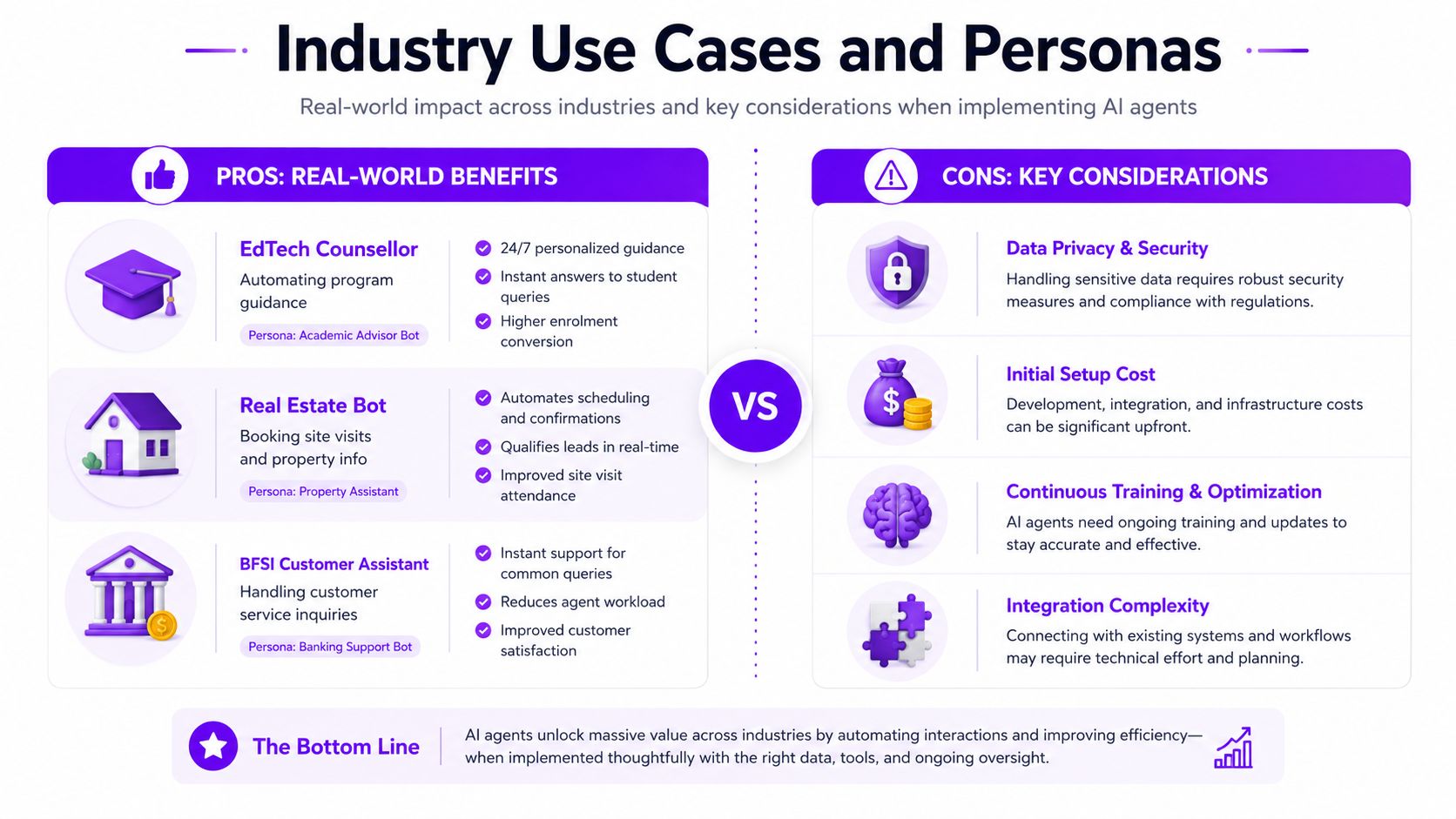
The fastest way to judge AI voice value is to start with the caller's job, not the tool stack. A learner asking about courses, a shopper checking a refund, and a patient confirming an appointment all need different flows, and the system should match that difference from the start. India-specific data shows AI agents reach 97% accuracy in structured dialogues and 85–90% in complex, unstructured interactions, so the practical move is to separate high-certainty workflows from open-ended ones instead of treating every call the same (India AI calling agent accuracy data).
Six persona snapshots
An EdTech counsellor can use an AI agent to answer course questions, collect basic qualification details, and book counselling calls without making a learner wait for office hours. An EdTech counsellor and a real estate booking bot are good examples of scale pressure in India, where call volume rises quickly and human teams cannot stay on every first response. A real estate booking bot can capture location preference, budget, and site-visit timing, then pass the lead to a human broker with context intact.
A BFSI service agent can support KYC guidance or trading support where the workflow is structured and auditable. A customer support assistant for e-commerce can resolve order status, refund checks, and delivery updates. A healthcare scheduler can book appointments and manage reminders, which fits voice workflows already used for scheduling, triage, adherence, and refill support.
A SaaS presales agent can qualify inbound interest and book demos, which keeps sales teams focused on higher-value conversations. For teams building outbound qualification flows, the guide to AI for sales development is useful because it shows how intent capture and follow-up shape conversion.
Where the line should be drawn
The operating rule is simple. Use AI first where the task is constrained and the success criteria are clear. Hold back where the conversation is emotional, ambiguous, or compliance-heavy.
That is especially important in India, where call-center leaders often face a scale problem before they face a feature problem. The question is not whether the agent can sound natural, it is whether it can handle repeated demand without losing accuracy, context, or auditability. CXOs should therefore map each persona to a call type, then decide whether the goal is full automation, assisted handling, or fast transfer to a human team.
Operational takeaway: Structured calls belong to the machine first. Unstructured calls should be designed for rapid human escalation, not forced automation.
That split lets CX leaders scale without weakening trust. It also keeps the ROI discussion honest, because the system is being measured against the kind of work it can do well.
Implementation Roadmap and Best Practices
A useful rollout starts with the work, not the logo. Teams that treat an ai call center agent like a voice layer on top of messy operations usually run into avoidable delays, while teams that define the call flow, the backend action, and the handoff rules first tend to see value faster. The point is simple. A voice agent is only as useful as the process it can complete.
Start with the right data
The first step is data preparation. Teams need labelled examples of the intents the agent should handle, plus the expected outcome, escalation triggers, and compliance notes. That training set is the equivalent of a well-organized call library, it gives the system examples of what “good” looks like instead of forcing it to guess from scattered transcripts.
Google's CCI guidance referenced in the research brief recommends clear questions, specific answer options, real examples, and enough labelled conversations to improve accuracy, with at least 100 example conversations per question and 40 per answer choice (RFP and QA guidance for AI contact centres). For CXOs, the lesson is practical. Better inputs shorten the path to reliable automation, and they reduce the chance that the agent sounds fluent while still missing the actual intent.
Train for speed, then for breadth
After the data is prepared, the team should train the agent for the highest-volume, lowest-ambiguity calls first. Order status, appointment scheduling, payment reminders, and callback handling are the usual starting points because they have clear objectives and predictable branches. Once those flows work, the scope can widen.
AHT, or average handle time, only improves if the system can complete the task, not just keep the caller engaged. That is why the first model should focus on resolution paths, slotting questions, confirmations, and clean exits. A voice agent that can close the loop on a routine request works like a skilled front-desk operator, it gathers the needed details quickly and hands off only when the issue falls outside the playbook.
Test integration before scaling
The agent should be tested against CRM, knowledge bases, ticketing systems, and audit flows before the rollout expands. If the call is meant to update a customer record, create a ticket, or trigger a follow-up, those actions have to work in the live stack, not just in a demo environment. In regulated settings, the handoff should carry the transcript, the caller's identity context, and the task already in progress.
That reduces repeat questioning and keeps the human agent from starting over. It also exposes integration gaps early, which matters more than polished speech in the first pilot stage. The operational standard is straightforward, if the AI cannot complete the backend action, it has not resolved the call, it has only postponed the work.
Roll out in phases
Start with low-risk workflows, then move into more complex ones after the team has proof. A recruitment screener can be a better pilot than a disputed billing line because the language is narrower and the escalation path is cleaner. That kind of phased rollout helps leaders compare pilot results against real service outcomes instead of guessing from feature lists.
Continuous tuning should happen after launch, not before. Live conversations reveal edge cases that lab testing misses, such as unclear accents, partial answers, or callers who change the topic mid-call. For teams that want a production stack, DialNexa Labs Private Limited provides voice AI agents for qualification, support, recruitment, and presales workflows across sectors. That platform choice makes sense only after the workflow is defined, the metrics are agreed, and the escalation path is clear.
Key Performance Indicators and ROI Examples
A call centre AI can sound polished and still fail the business. CXOs need proof that it resolves work, hands off cleanly, and lowers cost without harming experience. The clearest way to judge it is to combine the metrics contact-centre leaders already trust with AI-specific measures that show what the automation accomplishes.
Start with the metrics leadership already knows
First-Contact Resolution, or FCR, shows whether the issue was solved in the first interaction. Microsoft says the industry average sits around 70-75%, world-class performance is 85%+, and top performers are moving toward 90% (Microsoft AI agent performance measurement). For a refund assistant, order-status bot, or service-line agent, that gives leadership a simple test. Is the system closing the loop, or just passing the caller along?
Average Handle Time, or AHT, is calculated as (talk time + hold time + after-call work) ÷ total calls handled. Service level is measured as calls answered within the threshold ÷ calls offered × 100 (call-centre metric formulas). These formulas matter because they map directly to staffing plans, queue pressure, and how much work each agent, human or AI, is carrying.
Add the AI-native measures
The AI layer needs its own scorecard. Balto identifies containment rate, intent recognition accuracy, escalation rate, CSAT by bucket, repeat contact rate, and cost per contact as core voice-AI metrics for executive review (AI voice-agent KPI framework). CloudTalk groups similar measures into operational efficiency, customer experience, and AI accuracy, which helps when the leadership team wants one dashboard instead of several disconnected reports.
That framework is easier to use when the metrics are tied to the deployment itself. The metrics for contact-centre voice AI deployments guide is useful because it aligns operational and business KPIs in one structure, so leaders can compare containment, handoff quality, and service impact without mixing definitions.
Read the ROI in the right way
The India-focused voice-AI research in the brief says mature deployments can resolve 60-75% of tier-1 service volume end-to-end, and another India analysis says AI can handle 60-80% of routine inbound call volume, with cost per resolved contact falling from roughly ₹55-₹85 for a human agent to ₹5-₹15 for AI on the automated segment (India voice AI economics). For Indian operations, that scale problem matters. A system that looks modest in a pilot can produce large operating gains once it is applied to high-volume, repetitive calls.
The right comparison is not call volume alone. It is resolution quality, handoff quality, and cost per contact on the calls that the AI should own. A bot that clears simple status checks and payment reminders at a lower unit cost creates measurable savings, but only if repeat contacts do not rise and human agents are still seeing the right context when escalation happens.
Decision rule: Do not ask whether AI reduces calls. Ask whether it resolves the right calls, at the right quality, at a lower cost per contact.
For CXOs, that is the shortest path to an ROI view that holds up in budget reviews. Start with FCR and AHT, add containment and escalation quality, then test the economics against your own call mix, because a key benefit comes from volume moved off the human queue without breaking the customer experience.
Common Pitfalls and Mitigation Strategies
Most AI call centre failures do not come from the model alone. They come from weak assumptions, thin data, and overconfidence in automation. The pattern is predictable, which makes it easier to control before it reaches the customer queue.
Bad data creates brittle conversations
If the training data is incomplete, the agent can sound polished in a demo and confused in production. That usually happens when teams underbuild the intent library or skip the edge cases that appear in real call flows, especially in Indian contact centres where the same request may come through different languages, accents, and account types. The fix is iterative data review, human annotation, and regular conversation audits so the model keeps learning from actual customer behaviour.
Latency problems damage trust fast
Even when the answer is correct, a slow reply feels broken. In voice support, latency works like a pause in a live conversation, the customer starts talking over the system, repeats information, or drops the call. That is why the under-800 ms latency guidance for Indian deployments matters in the architecture discussion (latency guidance for Indian deployments).
Over-automation hurts more than it helps
Some teams push the AI too far into open-ended or emotionally charged calls. The model may still sound confident, but confidence is not the same as judgment. Complex conversations need escalation design, not just better prompting.
Independent guidance in the research brief stresses that effective voice AI should handle routine requests and pass the rest to a human agent, with strong CRM integration and clean handoffs (healthcare and enterprise handoff guidance). In practice, that means the AI should collect context, pass the transcript, and let the human continue without asking the customer to repeat the story.
Compliance can't be bolted on later
Regulated use cases in BFSI and healthcare need audit trails, consent handling, and clean record updates during the same interaction. If those controls are missing, the pilot may still look impressive in a dashboard, but it can fail the legal or operational test once it meets real customer data.
For leaders tracking the policy side as well, the US and EU voice AI regulatory updates guide is worth reviewing alongside internal compliance checks.
Vendor Selection and Pilot Design
The right vendor can accelerate deployment. The wrong one can trap the company in a polished demo with no operational fit. CXOs should evaluate vendors on how the agent handles real work, not how well the sales deck explains the future.
Start with architecture. Ask how the platform handles streaming ASR, low-latency response generation, CRM updates, transcript storage, and escalation. Then check multilingual support, because India's call flows often move between English and regional languages in the same conversation. Ask for proof of compliance readiness, audit logs, and how the platform supports supervised handoff when the agent reaches its limit.
A pilot should be designed like a business test, not a technology showcase. Pick a narrow intent set, define a clear success metric, assign a sample call volume, and review results in a dashboard that the operations team can effectively use. If the pilot covers too many call types, nobody can tell whether the results came from the model, the data, or the workflow design.
Pilot rule: A good pilot proves one thing cleanly. It doesn't try to impress everyone at once.
The RFP should also force clarity on pricing, because usage-based economics are very different from seat-based licensing. Ask how the vendor bills conversations, summaries, handoffs, and quality checks. Then compare that to your own contact-centre volume, staffing model, and escalation rate.
One more filter matters. Ask whether the vendor can preserve context during human transfer. If the caller has to start again, the “automation” has just created a second queue.
Getting Started with AI Call Center Agents
The first move is internal alignment. CX, operations, sales, support, compliance, and IT all need to agree on which call types are safe to automate first and which ones need human ownership from day one. That shared view prevents the project from turning into a tool buying exercise with no operational accountability.
Then build the baseline. Measure current FCR, AHT, escalation volume, repeat contact rate, and the cost per resolved contact before launch. Without that baseline, no one can tell whether the pilot improved the business or just changed the shape of the queue.
The easiest early win is usually a narrow, high-volume workflow such as appointment scheduling, lead qualification, or order-status checks. Those calls are predictable, repetitive, and easy to benchmark against a human process. Once the agent proves it can resolve routine work reliably, the team can extend it into adjacent intents.
The broader lesson is simple. An AI call center agent is not a replacement for customer service leadership, it's a way to make leadership decisions measurable at a much larger scale. India's missed-call problem has already made the case for urgency, and the technical and operating benchmarks now give CXOs a way to act on it with discipline.
A CTA for DialNexa Labs Private Limited. If you're planning an AI call centre pilot, start by mapping one high-volume workflow, setting your baseline KPIs, and testing a voice agent against real calls with clear escalation rules.

Leave a Reply