
Conversational Customer Service: A CXO’s Guide for 2026
Indian customers lose 10.8 hours per year resolving customer service issues, according to the ServiceNow Customer Experience Report 2025 covered by ET Brand Equity. For a board or leadership team, that number reframes conversational customer service. This isn't a chatbot discussion. It's a productivity, retention, and operating model discussion.
For Indian businesses, the winning question is no longer whether customers will accept AI-led service. The sharper question is where a voice-first conversational model can reduce friction, protect margin, and improve customer access without damaging trust. In a market where customers still value the phone call, but also expect immediate answers, conversational customer service sits at the intersection of scale and familiarity.
Table of Contents
- The End of Waiting Your New Competitive Advantage
- The Great Channel Shift From Voice Calls to AI Conversations
- Deconstructing the Conversational Service Engine
- Measuring Business Impact Beyond Handle Time
- Conversational Use Cases Across Indian Industries
- A Phased Roadmap to Successful Deployment
- The Future of Customer Relationships Is Conversational
The End of Waiting Your New Competitive Advantage
Every unresolved query costs twice. The customer loses time. The company absorbs avoidable contact load, repeat interactions, and preventable frustration. That's why conversational customer service matters now. It addresses a visible customer pain point and an often-hidden operational leak at the same time.

A useful board-level definition is simple. Conversational customer service is a service model where customers can speak or type naturally, get context-aware responses, move across touchpoints without starting over, and reach a human smoothly when the issue needs judgement or empathy. The difference from older automation is that the experience feels like a guided interaction rather than a menu maze.
What boards should actually care about
The strategic value isn't limited to faster replies. A well-designed conversational layer changes how service operations work.
- It removes low-value repetition: Routine questions stop consuming the same human capacity every day.
- It improves access outside business hours: Customers don't need to wait for office timing to complete simple tasks.
- It creates cleaner operational signals: Teams can see recurring intents, handoff points, and service gaps more clearly.
- It protects specialist capacity: Skilled agents spend more time on exceptions, escalations, and revenue-adjacent conversations.
Practical rule: If a service issue follows a repeatable pattern, a conversational workflow should handle the first layer of it.
Why this is more than an IT purchase
Leaders often evaluate conversational AI as software. That's too narrow. The better frame is service redesign. If customers can resolve status checks, appointment scheduling, application updates, document guidance, or order questions through natural dialogue, then the contact centre stops behaving like a queue and starts behaving like an always-on access layer.
That matters in sectors where inbound demand spikes unpredictably. An EdTech admissions team during enrolment season, a BFSI support desk during compliance cycles, or an e-commerce operation during delivery disruptions all face the same problem. Human teams can't elastically scale every hour of the day. Conversational systems can absorb the predictable layer of demand.
The best ROI rarely comes from replacing agents. It comes from removing avoidable work so agents can handle the moments that actually need people.
The companies that gain from conversational customer service aren't just automating answers. They're reducing waiting as a category of customer experience failure.
The Great Channel Shift From Voice Calls to AI Conversations
The Indian market is changing fast, but not in the simplistic way many vendor decks suggest. Voice isn't disappearing. Poorly designed, labour-heavy voice operations are. The shift is from human-only voice to AI-supported conversations across voice and self-service.
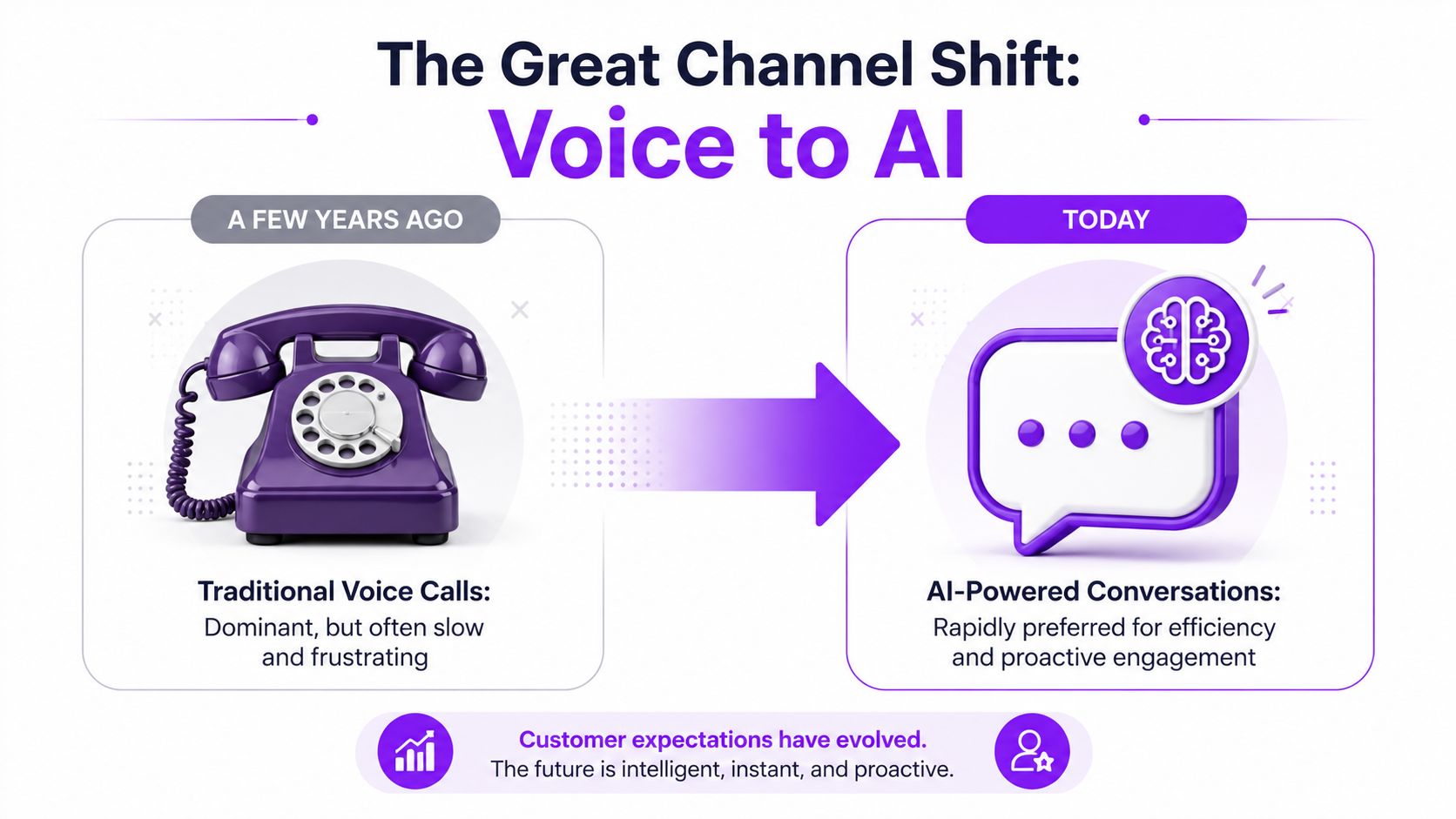
Early in this transition, the pattern was already visible. India CX market data compiled by Wisemonk notes that voice interactions accounted for 64% of CX volume in India in 2020 and are projected to decline to 25% by 2030, while AI bots and self-service channels are expected to rise from 4% to 44%. That's not channel drift. It's operating model restructuring.
A simple visual helps frame the movement:
What the shift really means
Most executives misread this trend in one of two ways. Some assume AI means chat-only service. Others assume voice will remain dominant because customers still call. Neither view is sufficient.
The better interpretation looks like this:
| Then | Now |
|---|---|
| Voice volume indicated customer demand | Voice design quality determines whether demand is handled efficiently |
| IVR routed calls through rigid menus | Conversational systems interpret intent and guide the interaction |
| Digital channels sat beside the call centre | Digital and voice increasingly share one service logic |
| Agent effort scaled service | Workflow design and AI containment increasingly scale service |
Why the market is moving
Customers want speed, continuity, and low effort. When a business can provide those through natural conversation, channel preference starts to shift around task type. Simple tasks move toward automation first. Complex issues still need human involvement, but even there, AI can capture intent and prepare context before transfer.
That's why the current stack matters. Teams evaluating speech systems should understand the basics of transcription quality, intent recognition, and multilingual capture. A practical reference is HyperWhisper's guide to voice recognition, which outlines how voice recognition quality affects downstream workflows.
Later in the evaluation process, leaders should also compare pure chatbot tools with broader orchestration platforms that can manage workflow logic across support, qualification, and handoff. A useful starting point is this overview of conversational AI solutions.
After the strategic picture is clear, this video is a useful primer on how conversational service is evolving in practice:
The board-level implication
A CXO shouldn't ask, “Should we add a bot?” The better question is, “Which interactions should move to AI-led conversation first, and where do we preserve human-led service?”
If your service design still assumes every issue deserves the same human workflow, your cost base will rise faster than your customer experience improves.
The organisations that adapt well won't eliminate voice. They'll redesign it so voice becomes intelligent, available, and selective about when human effort is necessary.
Deconstructing the Conversational Service Engine
The fastest way to make a poor buying decision is to evaluate conversational customer service as a front-end script. This system has multiple layers, and each one affects customer trust. For Indian businesses, voice capability is central because customer behaviour still leans heavily toward calls. According to a Truecaller report covered by Mint, 76% of Indian consumers still prefer phone calls over digital channels for business communication.
That single fact changes implementation priorities. If voice is still the preferred business interface for most consumers, then a conversational system that works only in chat is incomplete.
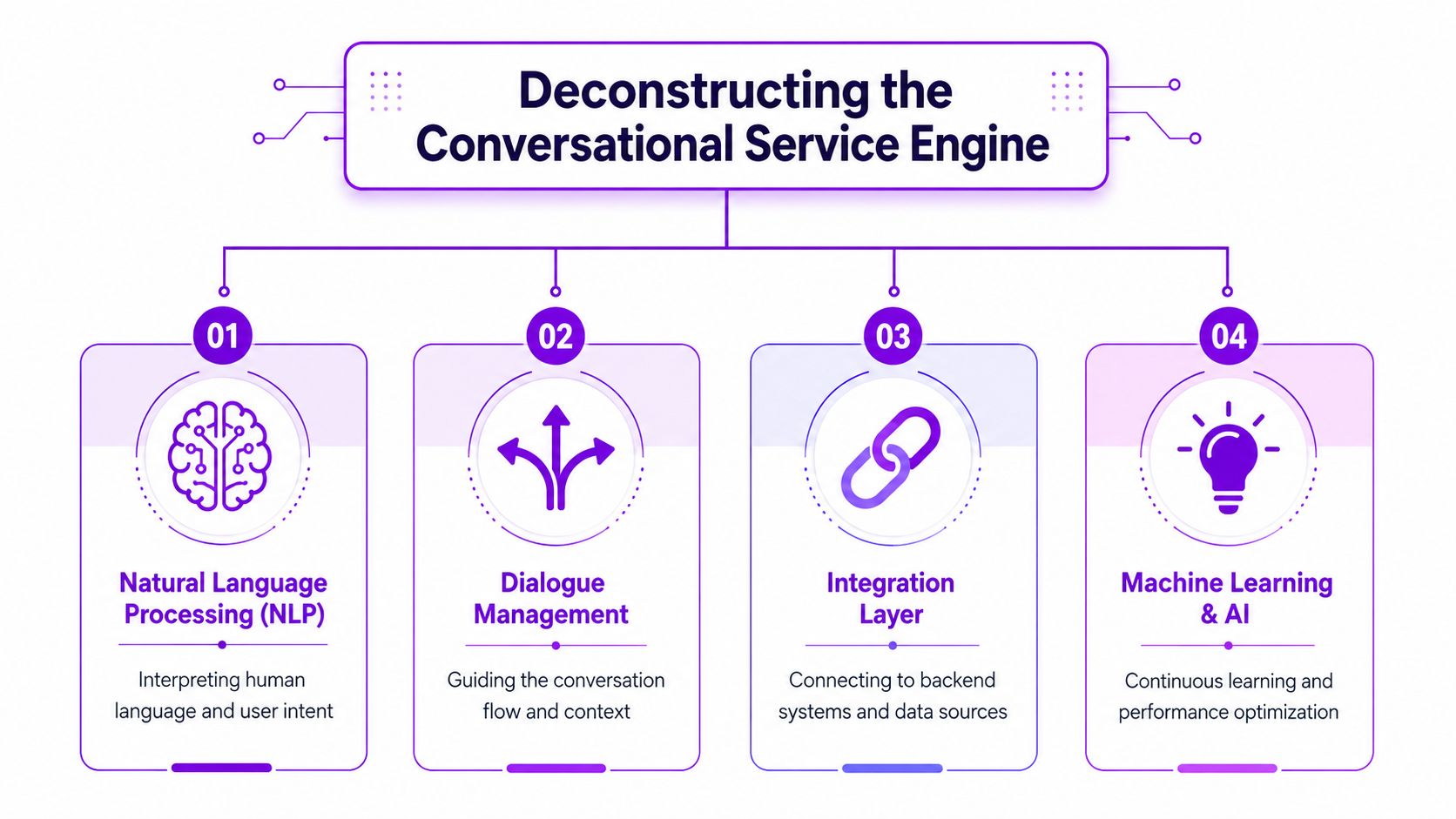
The four layers that matter
A useful executive model is to think of the conversational engine as four business capabilities.
Natural language processing
This is the brain. It interprets what the customer means, not just the words used. In practice, that means recognising whether “I haven't got my refund”, “refund ka update chahiye”, and “my money hasn't come back yet” are the same service intent.
Without strong NLP, automation becomes brittle. Customers have to adapt to the system instead of the other way round.
Dialogue management
This is the conversation manager. It decides what to ask next, what context to retain, and when to confirm details. Good dialogue management prevents circular exchanges and reduces the need for customers to repeat themselves.
For a BFSI workflow, this can mean separating a balance enquiry from a KYC-related issue early. For a university admissions flow, it can mean moving from course interest to eligibility to counselling slot booking in one coherent path.
Integration layer
This is the connector. It links the conversational interface to CRM, ticketing, order systems, admissions tools, policy data, appointment calendars, or payment status.
A conversational agent without integrations can answer questions in general terms. A connected one can act. That distinction matters. Boards fund outcomes, not demos.
Machine learning and optimisation
This is the improvement loop. Teams review containment, failed intents, transfer reasons, and missed answers, then update flows and knowledge.
A conversational system becomes valuable when it learns from operations, not when it simply sounds human.
Why voice-first design is different in India
Many global articles focus on web chat because it's easier to deploy. That misses the Indian service reality. Voice-first design has to handle accent variation, mixed-language phrasing, interruptions, and informal sentence structure. It also has to sound credible enough that customers stay in the interaction instead of trying to force a transfer.
That's why leaders should examine not just bot-building features, but speech quality, recovery logic, multilingual tuning, and handoff behaviour. For a broader business lens on this point, Busylike's piece on how teams can drive growth with conversational AI is useful because it links engagement design to commercial outcomes rather than treating AI as a novelty.
For organisations assessing implementation models, a related capability worth understanding is the knowledge-driven agent. If the system can't reliably draw from approved internal content, it will fail under live pressure. This explainer on a knowledge-based agent in AI is a good companion topic for evaluation teams.
One practical vendor filter
Ask every provider the same thing: how does the system behave when the customer speaks naturally, mixes languages, changes intent mid-conversation, or asks for a human?
If the answer centres on ideal flows rather than failure recovery, the product is probably optimised for demos, not production.
Measuring Business Impact Beyond Handle Time
Many executive dashboards still overemphasise average handle time. That metric matters, but it's a partial view. It rewards speed even when speed doesn't solve the customer's problem. Conversational customer service requires a broader scorecard because its value comes from containment, routing quality, continuity, and service capacity.
The most useful benchmark in the current Indian context is automated resolution rate. According to the Crisp benchmark cited for the Indian market, AI-powered conversational agents now achieve automated resolution rates of approximately 72%. That's strategically important because it measures work removed from the human queue, not just calls shortened.
A better KPI set for the boardroom
If your board pack still treats service mainly as a labour management problem, you'll miss the full return.
| Traditional Metric | Modern Conversational KPI | What It Measures |
|---|---|---|
| Average Handle Time | Automated Resolution Rate | How much demand the system resolves end-to-end without human intervention |
| First Call Resolution | Contained Interaction Quality | Whether the issue was solved correctly within the automated flow |
| Calls Per Agent | Human Capacity Released | How much specialist time is freed for high-value or sensitive work |
| Queue Length | Handoff Precision | Whether escalations reach the right team with context intact |
| Cost Per Call | Cost Per Contained Interaction | The operating efficiency of resolving routine work through AI-led flows |
What this changes in practice
Consider four familiar scenarios.
- Support operations: A contained password reset, delivery update, or account status query no longer consumes a live agent slot.
- Sales support: Lead qualification can happen before a counsellor or advisor spends time on low-fit enquiries.
- Compliance-heavy environments: Structured questioning and standard prompts reduce inconsistency in early-stage interactions.
- Executive planning: Service teams can forecast staffing around exception handling rather than total inbound volume.
This is also where analytics starts to influence brand visibility and discoverability in AI-shaped environments. Teams exploring how conversational data affects presence in AI-mediated touchpoints may find MyMentions' perspective on how to improve brand rank in AI conversations useful.
Why handle time can mislead leadership
A short interaction isn't automatically a successful one. If a customer has to call again, or gets transferred without context, the business has only moved work around. Conversational systems should be judged on whether they remove repeatable work and improve the consistency of early-stage resolution.
For service leaders who still report legacy efficiency metrics, this guide to average handling time is helpful because it clarifies where the metric remains useful and where it stops being sufficient.
Boards should ask one harder question: which interactions disappeared from the human queue entirely, and what did the business do with the capacity that created?
That's where ROI becomes visible. Not in shorter calls alone, but in a service operation that handles routine demand differently and deploys people where judgement matters more.
Conversational Use Cases Across Indian Industries
Industry use cases matter because conversational customer service doesn't create value in the abstract. It creates value when a business maps it to a specific demand pattern, customer expectation, and service risk.
In India, that mapping has to account for language reality. According to Zoice's analysis of conversational AI in India, 56.3% of consumers use Hinglish, 50% use pure Hindi, and there is significant demand for Tamil at 31.3%, Telugu at 31.3%, Marathi at 25%, and Malayalam at 25%, while English remains foundational for only 93.8% of business communications. That makes multilingual capability a design requirement, not a feature add-on.
EdTech and higher education
Admissions and counselling pipelines often break when demand peaks. Prospective students ask the same questions repeatedly: eligibility, fees, class schedule, documentation, entrance process, and counselling availability.
A voice-first conversational workflow can take the first layer of this load. It can answer policy-level questions, capture programme interest, identify location or language preference, and book counselling slots. The practical gain is consistency. Counsellors spend less time repeating basic information and more time addressing fit, readiness, and objections.
A multilingual setup matters here because a student may begin in English, switch into Hindi, and use local phrasing when asking about deadlines or classes.
BFSI and trading platforms
In BFSI, the early interaction often determines whether the customer feels reassured or blocked. A conversational service layer can guide users through routine account assistance, explain next steps for verification, collect structured issue details, and route sensitive cases to trained agents.
The key is guardrails. Regulated sectors shouldn't aim for unrestricted free-form automation. They should automate the repeatable parts of customer contact while preserving clear escalation paths for exceptions, disclosures, and judgement-heavy cases.
In BFSI, good automation reduces ambiguity. Bad automation increases risk.
Real estate
Property enquiries often arrive with low structure. Buyers ask about unit type, location, budget, possession timelines, financing options, or site visit slots. A conversational agent can standardise the first conversation by capturing intent, filtering low-fit leads, and booking visits for sales teams.
Real estate teams often lose time on fragmented inbound demand, and a consistent voice workflow improves intake discipline without forcing prospects through a cold form-fill experience.
E-commerce and D2C
For retailers, the highest-volume service intents tend to be status-led rather than relationship-led. Customers want to know where the order is, whether a return was accepted, when a refund will appear, or how to modify a request.
These are ideal conversational workflows because they are repetitive, data-backed, and time-sensitive. The value isn't just lower support load. It's customer reassurance at the exact point where uncertainty creates repeat contacts.
One practical implementation example
A platform such as DialNexa can be used in these settings to run human-like Voice AI agents for support, qualification, presales, and booking workflows across sectors including EdTech, BFSI, real estate, e-commerce, and software. For CXOs, that kind of tool is relevant when the operating problem is high conversation volume combined with repeatable early-stage interactions.
The pattern across industries is consistent. Start with a high-frequency task. Keep language natural. Make the handoff clean. Then expand only after the workflow proves reliable.
A Phased Roadmap to Successful Deployment
Most conversational customer service projects fail for one of two reasons. Either the company starts too broad, or it confuses deployment with adoption. The right roadmap is phased, operational, and tied to a business problem.
Adoption is no longer fringe. According to a Bain and Meta survey reported by Business Standard, 70% of firms in India already use conversational platforms to engage with customers, and Customer Support is the dominant application for 43.8% of Indian organisations. The competitive risk now lies less in trying conversational systems and more in implementing them poorly.
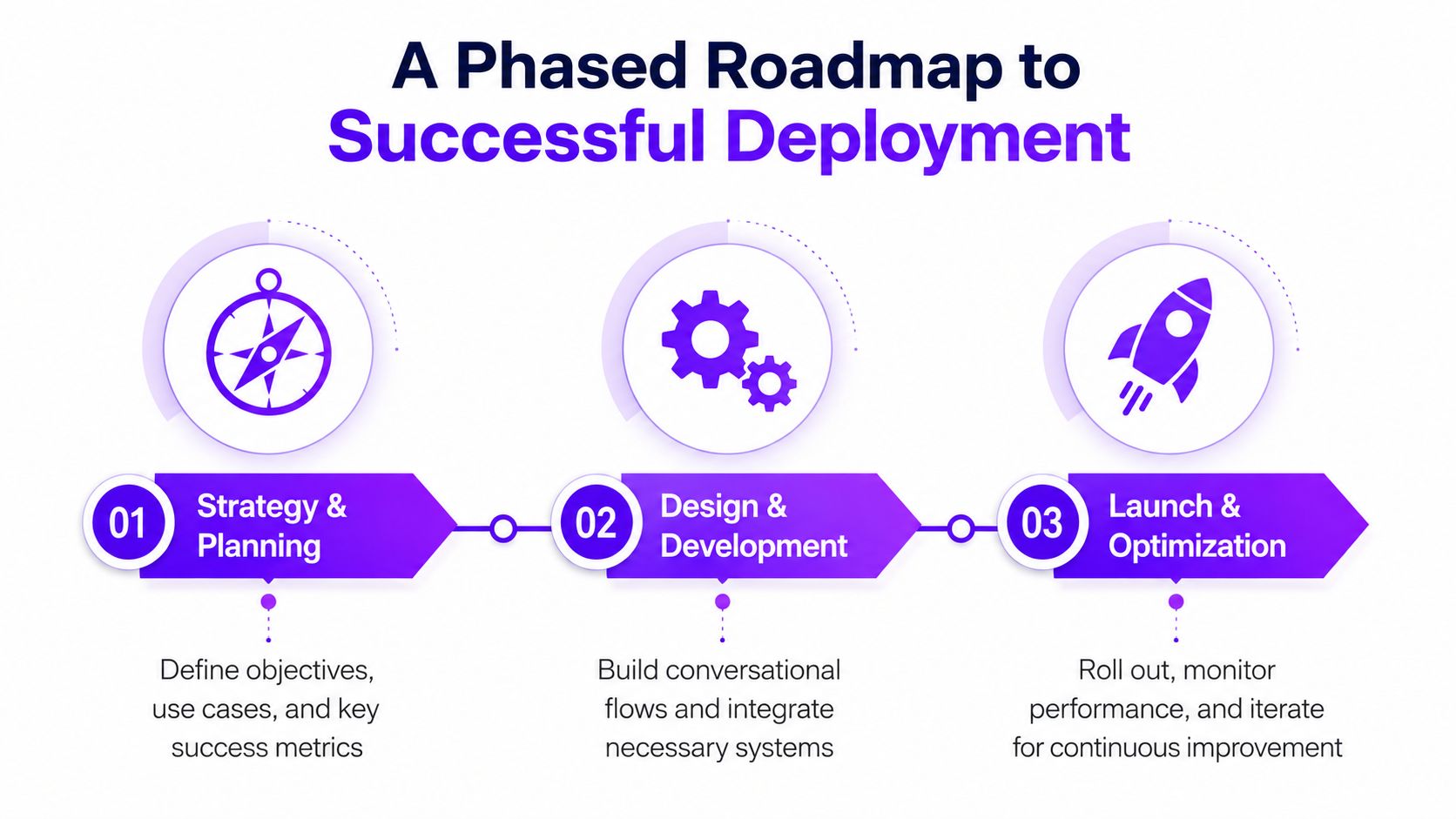
Phase one strategy and planning
Don't begin with channels. Begin with a workflow.
Choose one service problem with three traits. It should be high volume, operationally repetitive, and important enough that fixing it visibly improves customer access. Good candidates include order status, admission enquiry triage, appointment booking, account assistance, and basic support intake.
During this phase, leadership should define:
- Business objective: Lower avoidable inbound load, improve access, or speed up qualification.
- Primary success metric: Containment, transfer quality, or reduced repeat contact.
- Escalation rule: The exact moment a customer should move to a human.
- Channel priority: Voice first, chat first, or blended.
Phase two design and development
Many teams become too technical too early. The better sequence is conversation design first, tooling second.
Focus on the operating details:
- Write for speech, not script: Spoken interactions need shorter turns, clearer confirmations, and recovery prompts.
- Design the failure path: If the system doesn't understand, it should clarify or escalate without friction.
- Connect the systems that matter: CRM, ticketing, calendars, order systems, or admissions tools.
- Train using live language patterns: Include mixed-language phrasing, interruptions, and informal speech.
Boardroom checkpoint: If the design team can't explain the handoff logic in plain English, the workflow isn't ready for launch.
Phase three launch and optimisation
Start with a limited production environment. Don't expose the entire customer base on day one. Review transcripts, containment outcomes, fallback reasons, and customer exits. Then tighten the flow.
The strongest operators treat launch as the start of governance, not the end of a project. They create a weekly review rhythm across CX, operations, and business owners. That keeps the system aligned with policy changes, product updates, and recurring service failures.
Common failures to avoid
A short list helps here.
- No clear business case: “We need AI” is not a use case.
- Robotic persona design: Customers tolerate automation. They don't tolerate confusion.
- Weak human handoff: Forcing customers to repeat context destroys trust quickly.
- Ignoring language reality: A system that works only in polished English won't hold in many Indian service settings.
- Treating the pilot as proof of scale: Early success is useful, but scale introduces new edge cases.
The strongest deployments are deliberate. They solve one workflow well, prove operational value, and expand from evidence rather than enthusiasm.
The Future of Customer Relationships Is Conversational
Conversational customer service is becoming the new front door to the business. Not because it is fashionable, but because it aligns with how customers want help delivered. They want access without delay, answers without repetition, and a path to a human when the issue becomes sensitive or complex.
For Indian companies, the strategic nuance is clear. The future isn't chat-only. It is voice-first, multilingual, and operationally integrated. That combination lets businesses preserve the familiarity of a phone conversation while gaining the scale and consistency of AI-led workflows.
The strongest organisations will use conversational systems to remove routine friction and redeploy human effort to the moments where trust, judgement, and persuasion matter most. That's what shifts customer service from a cost centre mindset to a relationship infrastructure mindset.
Boards should treat this as a long-term capability build. The companies that win won't be the ones with the biggest support teams. They'll be the ones that make it easiest for customers to get something done.
DialNexa Labs Private Limited helps organisations design and deploy voice-led conversational workflows for support, qualification, presales, and booking use cases. If your team is evaluating how to modernise customer access without adding avoidable operational load, explore DialNexa Labs Private Limited as one option for building structured, human-like Voice AI around real business workflows.

Leave a Reply