

Before You Begin
Decide whether you need a DialNexa-provisioned number or an existing SIP number. For number purchase, confirm account readiness and wallet balance. For live routing, publish and test the agent version first.Buy A Number
1
Open Phone Numbers
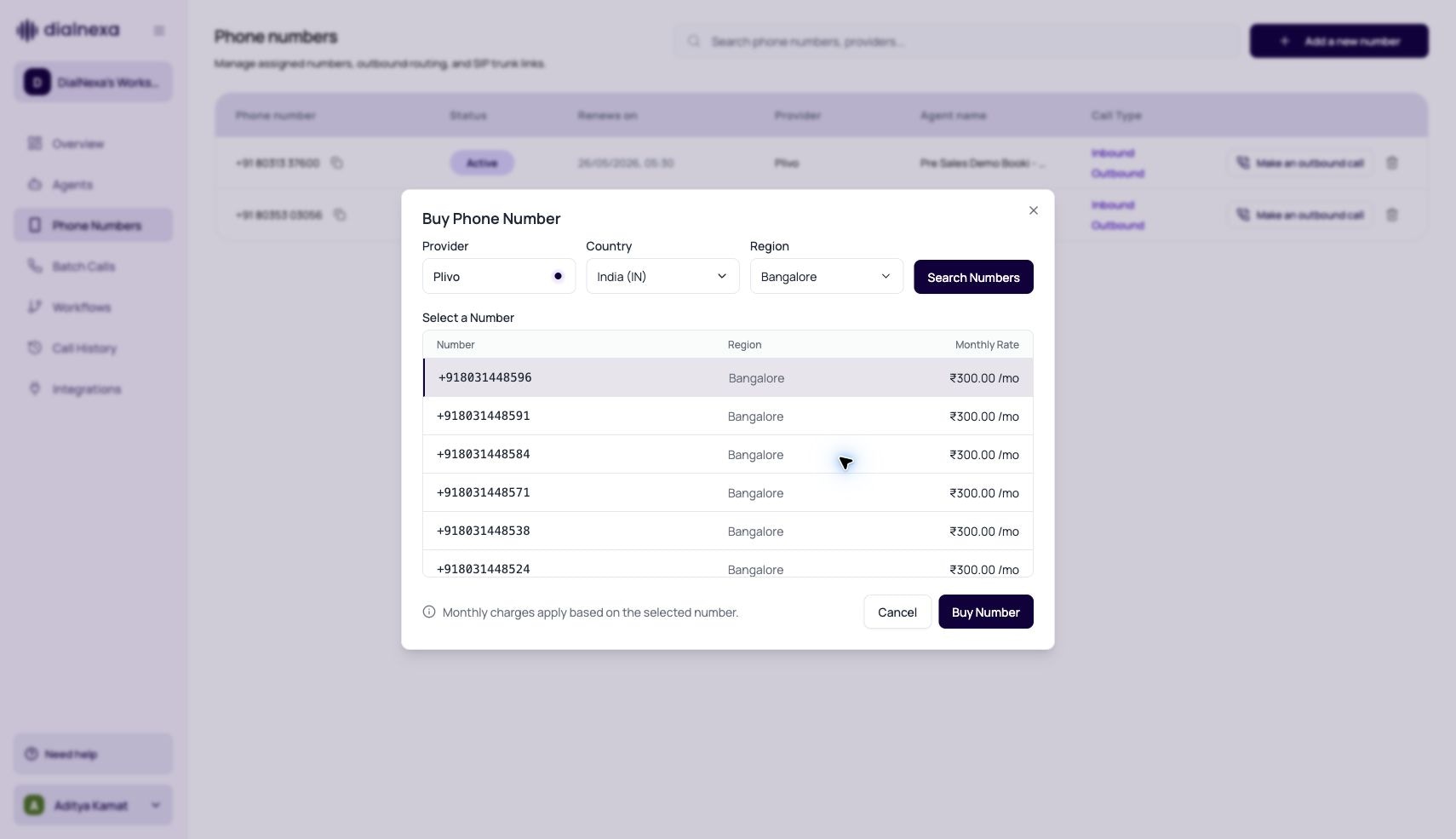
In the left sidebar, click Phone Numbers, then click Buy Number.
2
Pick country and region
Select the destination country and, where offered, a region or number type. The modal lists available numbers with their monthly rate.
3
Select a number and confirm the rate
Pick a number from the list and review the monthly rental cost shown next to it. The cost is billed from your wallet.
4
Purchase
Click Buy. The number appears in your Phone Numbers list within a few seconds. If provisioning stays pending, check your wallet balance first.
Buying a number only creates the route. Callers reach an agent only after you assign an inbound agent that has a published version, and outbound calls also require KYC verification.
Shared India Default Number
For workspaces moved to the updated shared India route, the default caller ID is +91 22 6998 2589. Confirm the current number in your workspace Phone Numbers list before sharing or hard-coding it. The update keeps the workspace phone-number ID and existing agent links, batches, and historical call references. Numbers with an active rental subscription are not moved by this shared-number update.Number Types In The Dashboard
Buy Number Compliance Gates
The Buy Phone Number modal supports United States and India purchase flows, but the dashboard can block a country before search when the workspace is not ready.
When a country is blocked, its dropdown option is disabled with a tooltip, the search button is disabled, and an inline warning explains what must be completed first. The US message points users back to KYC verification. The India message asks users to submit compliance documentation and complete KYC verification.
If a country is available, users can select the region, search available numbers, review monthly rental pricing, and purchase from the returned list. If search stays disabled after readiness is complete, refresh the organization context and confirm the workspace has the latest KYC and compliance state.
For India city searches, DialNexa first sends the city name to the provider. If no numbers are returned for Bangalore or Bengaluru, it retries once with STD code
80. A Mumbai search retries once with STD code 22. An empty result after the retry means no matching inventory was available at that time.
Phone Number Fields Users Should Recognize
Agent Phone Number Limits
Each agent can have up to three inbound and three outbound numbers, and every version of the agent uses them. A number can ring one agent and be dialed from by one agent; the two can be different agents. To switch a number to another agent in a direction, move it as described in Move a number between agents. You can also manage an agent’s numbers from the Phone numbers button in the agent builder, or through the agent phone numbers API. A number cannot be removed from an agent, or deleted, while calls are live on it. For outbound use, it also cannot be removed while a running, paused, scheduled, or waiting batch dials from it, or while an active workflow uses it.Phone Number Nicknames
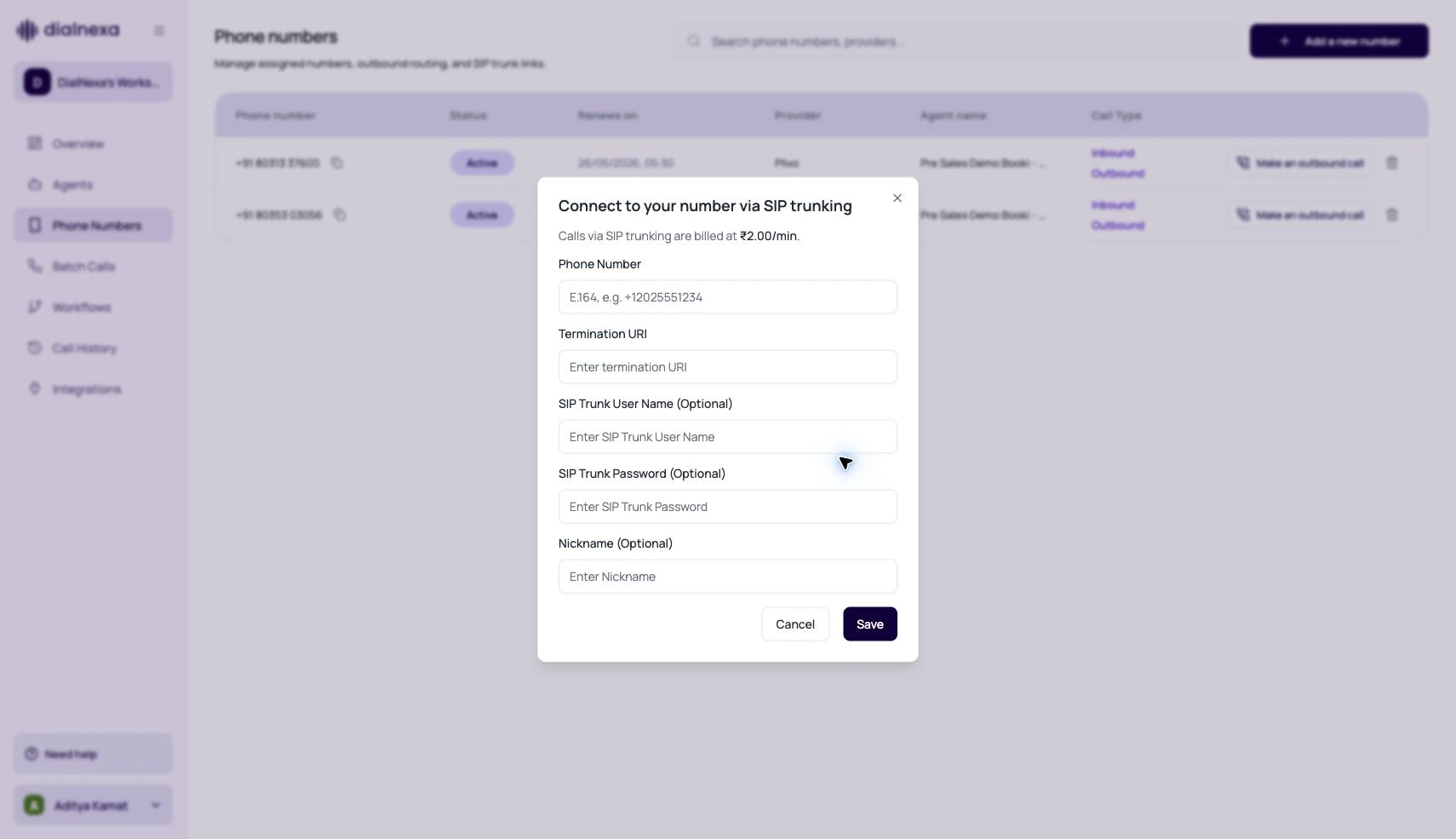
A nickname is a label for a number, such asSupport line or Mumbai sales. On Phone Numbers, open a number and choose Add nickname or Edit nickname. Leading and trailing spaces are removed, and saving an empty nickname clears it. A nickname can be up to 255 characters, and you can also set one when you link a SIP trunk.
Where a nickname is set, the agent phone number selectors show it in place of the number, with the number underneath, so the right route is easy to pick. Batch call setup and workflow call nodes still show the number itself. Over the API, the nickname is the nickname field on List Phone Numbers and Get Phone Number Details.
Inbound And Outbound Assignments Are Separate
The Phone Numbers table shows assigned agent context and call direction for each number. Publish the agent to update the version used by inbound calls. The table row itself is not where you rename agents or edit published versions.Telephony Pricing Behavior
Source number country does not decide outbound destination pricing. The called number does.
Outbound Destination Validation
Single outbound calls and batch calls validate the destination before creating call records. The checks happen in this order:- The destination must be present, parseable, and possible as an international phone number.
- If KYC is not verified, the owner can only call the registered verification number.
- For non-SIP routes, the destination country ISO code must be enabled in Workspace Settings > Telephony.
- If the enabled network group has prefixes, DialNexa checks the most specific matching prefix for that destination country. A shorter enabled prefix does not allow a number whose more specific matching prefix is disabled.
- SIP trunk numbers and enabled SIP/BYOC workspace config bypass destination country rules.
+1 are evaluated by the resolved country, not only by the 1 calling code.
Prepare A Number For Production
1
Confirm active state
Pending or expired numbers should not be used for critical traffic.
2
Check readiness
Complete KYC or regional requirements where the dashboard asks for them.
3
Assign agents
Select the inbound and outbound agents that should own live calls. Each agent needs a published version.
4
Review Telephony
Confirm the destination countries and network groups you plan to call are enabled for this workspace.
5
Run one inbound test
Call the number and confirm the correct agent answers.
6
Run one outbound test
Start a call from the number and review status, recording, transcript, and extracted fields.
Common Phone Number Mistakes
Wrong agent answers
Wrong agent answers
Check direction. Inbound and outbound assignments are independent.
Draft changes do not affect calls
Draft changes do not affect calls
Inbound calls use the agent’s latest published version. Publish the draft before expecting callers to hear the change.
SIP number behaves differently from a purchased number
SIP number behaves differently from a purchased number
Test the exact SIP trunk path. Your carrier, trunk configuration, and caller ID behavior can change audio and routing.
Deleting without checking usage
Deleting without checking usage
Confirm whether the number is active, default, has live calls, or is used by batches or active workflows before deleting it. DialNexa refuses the delete while any of these apply, except active status.