> ## Documentation Index
> Fetch the complete documentation index at: https://dialnexa.com/docs/llms.txt
> Use this file to discover all available pages before exploring further.
# Agent History and Version Review in DialNexa
> Review DialNexa agent version history to understand what changed before a call quality issue, compare versions, and find the exact configuration that handled a specific call.
Agent history and version review let you see every published version of an agent, when it was published, and what it contained. This is your primary tool when call behavior changes unexpectedly and you need to understand what configuration was in place at the time.
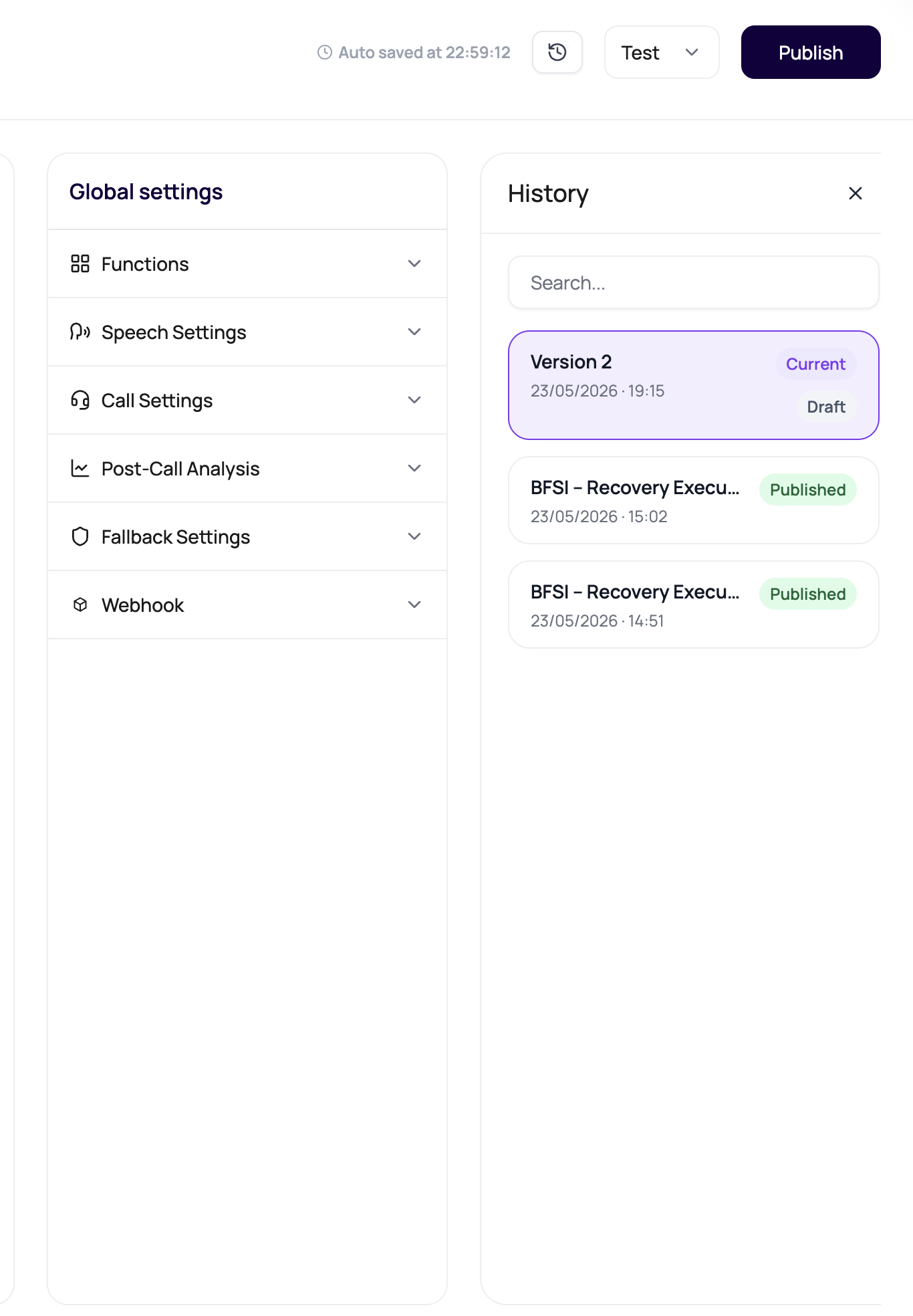 Version history is the product memory. Use it before relying on human memory, which has a proud tradition of inventing details.
## Where to Find Version History
Version history is accessible from the agent builder:
1. Open the agent from the Agents list.
2. In the builder, look for the **Version History** button or the version selector dropdown in the top bar.
3. Click it to open the version list. All published versions appear in reverse chronological order (most recent first).
Each row in the history shows:
* Version number (auto-incremented)
* Version title (the label you entered at publish time)
* Published timestamp
* Published by (user account, where shown)
* Whether this version is currently assigned to a live route
## What Each Version Shows
Clicking a version in the history opens a read-only view of that version's full configuration. You can inspect:
| Component | Viewable in history |
| ------------------------------------------ | ------------------- |
| System prompt | Yes |
| Welcome message | Yes |
| Voicemail message | Yes |
| Language, voice, LLM, transcriber settings | Yes |
| Temperature and other LLM settings | Yes |
| Functions and their configurations | Yes |
| Speech settings | Yes |
| Call settings | Yes |
| Post-call analysis field definitions | Yes |
| Dynamic variable defaults | Yes |
| Agent webhooks | Yes |
Published versions are immutable. You can view everything in a historical version but cannot edit it.
## What Version History Helps Answer
Use version history when you have a call quality question or a behavioral change you cannot explain.
| Question | How history helps |
| -------------------------------------- | -------------------------------------------------------------------------------------------------- |
| Which version handled a specific call? | Find the call in Call History, note the agent version field, then open that version in history. |
| What changed between two versions? | Open both versions and compare the prompt, stack, and settings side by side. |
| When did a behavior change? | Sort history chronologically and look for the version published around the time the issue started. |
| What was the prompt at launch? | Open version 1 and read the prompt as it existed on day one. |
| Who made a change? | The "published by" field shows which user account published each version. |
## Comparing Versions
DialNexa does not currently offer an automated diff view. To compare two versions:
Open the agent and navigate to version history.
Click the most recent version and copy the prompt and key settings into a text editor.
Click the earlier version you want to compare against. Review its prompt and settings.
Look for changes in: prompt text, voice or LLM model, temperature, transcriber, functions, variable defaults, and call settings.
Determine whether the changes between versions can explain the behavior difference you observed in calls.
Copy the prompt text from two versions and paste them into a diff tool (such as a text editor's compare feature or an online diff utility) to see line-level differences clearly. This is especially useful for long prompts where small word changes have significant effects.
## Finding the Version That Handled a Specific Call
When a caller complains or a call transcript shows unexpected behavior, you need to know exactly which version ran.
In the left sidebar, click **Call History** (or Calls > History depending on your navigation).
Search by phone number, date range, or call ID. Click the call row to open the call detail page.
The call detail page shows which agent and which version handled the call. Note the version number.
Go to the agent, open version history, and click the matching version number. This is the exact configuration that ran during that call.
A common mistake is opening the agent builder and reading the current draft, which may have changed since the call. Always look at the version from the call detail, not the current state.
## Using History During Debugging
Find the call in Call History and note the agent version number.
Do not debug the current draft. Open the exact version the call used.
Read the transcript alongside the prompt. Find where the agent deviated from expected behavior. Look for: wrong branching, a variable that rendered as a placeholder, a function that failed, or a missing end-call instruction.
Open the version before the one that caused the issue. Look for prompt, function, variable, and setting differences. The delta between versions is usually the root cause.
Make the smallest change that fixes the issue. Do not bundle multiple fixes into one version if you can avoid it. Smaller changes are easier to verify and easier to roll back.
After publishing the fix and updating routes, monitor the next 5 to 10 calls in Call History to confirm the issue is resolved.
## Review Before Rolling Forward
Before publishing a new version, a thorough review should cover more than just the prompt.
Confirm language, model, voice, transcriber, temperature, and speed are set as intended.
Check functions, speech settings, call settings, variable defaults, and webhooks.
Verify field names, types, and extraction descriptions match what your team expects.
Confirm inbound and outbound phone number assignments point to the correct version after publishing.
## Version History Limitations
Version history only shows published versions. In-progress draft edits that were never published do not appear in history. If you want to preserve a draft state before making major changes, publish it first with a descriptive title like "checkpoint before refactor".
There is no built-in side-by-side diff. Compare versions manually or copy prompt text to an external diff tool.
You can view and assign historical versions to routes, but you cannot edit them. To modify a historical version, duplicate it as a draft (where supported) or manually recreate the configuration in the current draft.
## Related Reading
Understand publish state, version immutability, and rollback.
Find the agent version that handled a specific call.
Test candidate versions before routing live traffic.
Understand how variable defaults are captured in versions.
Version history is the product memory. Use it before relying on human memory, which has a proud tradition of inventing details.
## Where to Find Version History
Version history is accessible from the agent builder:
1. Open the agent from the Agents list.
2. In the builder, look for the **Version History** button or the version selector dropdown in the top bar.
3. Click it to open the version list. All published versions appear in reverse chronological order (most recent first).
Each row in the history shows:
* Version number (auto-incremented)
* Version title (the label you entered at publish time)
* Published timestamp
* Published by (user account, where shown)
* Whether this version is currently assigned to a live route
## What Each Version Shows
Clicking a version in the history opens a read-only view of that version's full configuration. You can inspect:
| Component | Viewable in history |
| ------------------------------------------ | ------------------- |
| System prompt | Yes |
| Welcome message | Yes |
| Voicemail message | Yes |
| Language, voice, LLM, transcriber settings | Yes |
| Temperature and other LLM settings | Yes |
| Functions and their configurations | Yes |
| Speech settings | Yes |
| Call settings | Yes |
| Post-call analysis field definitions | Yes |
| Dynamic variable defaults | Yes |
| Agent webhooks | Yes |
Published versions are immutable. You can view everything in a historical version but cannot edit it.
## What Version History Helps Answer
Use version history when you have a call quality question or a behavioral change you cannot explain.
| Question | How history helps |
| -------------------------------------- | -------------------------------------------------------------------------------------------------- |
| Which version handled a specific call? | Find the call in Call History, note the agent version field, then open that version in history. |
| What changed between two versions? | Open both versions and compare the prompt, stack, and settings side by side. |
| When did a behavior change? | Sort history chronologically and look for the version published around the time the issue started. |
| What was the prompt at launch? | Open version 1 and read the prompt as it existed on day one. |
| Who made a change? | The "published by" field shows which user account published each version. |
## Comparing Versions
DialNexa does not currently offer an automated diff view. To compare two versions:
Open the agent and navigate to version history.
Click the most recent version and copy the prompt and key settings into a text editor.
Click the earlier version you want to compare against. Review its prompt and settings.
Look for changes in: prompt text, voice or LLM model, temperature, transcriber, functions, variable defaults, and call settings.
Determine whether the changes between versions can explain the behavior difference you observed in calls.
Copy the prompt text from two versions and paste them into a diff tool (such as a text editor's compare feature or an online diff utility) to see line-level differences clearly. This is especially useful for long prompts where small word changes have significant effects.
## Finding the Version That Handled a Specific Call
When a caller complains or a call transcript shows unexpected behavior, you need to know exactly which version ran.
In the left sidebar, click **Call History** (or Calls > History depending on your navigation).
Search by phone number, date range, or call ID. Click the call row to open the call detail page.
The call detail page shows which agent and which version handled the call. Note the version number.
Go to the agent, open version history, and click the matching version number. This is the exact configuration that ran during that call.
A common mistake is opening the agent builder and reading the current draft, which may have changed since the call. Always look at the version from the call detail, not the current state.
## Using History During Debugging
Find the call in Call History and note the agent version number.
Do not debug the current draft. Open the exact version the call used.
Read the transcript alongside the prompt. Find where the agent deviated from expected behavior. Look for: wrong branching, a variable that rendered as a placeholder, a function that failed, or a missing end-call instruction.
Open the version before the one that caused the issue. Look for prompt, function, variable, and setting differences. The delta between versions is usually the root cause.
Make the smallest change that fixes the issue. Do not bundle multiple fixes into one version if you can avoid it. Smaller changes are easier to verify and easier to roll back.
After publishing the fix and updating routes, monitor the next 5 to 10 calls in Call History to confirm the issue is resolved.
## Review Before Rolling Forward
Before publishing a new version, a thorough review should cover more than just the prompt.
Confirm language, model, voice, transcriber, temperature, and speed are set as intended.
Check functions, speech settings, call settings, variable defaults, and webhooks.
Verify field names, types, and extraction descriptions match what your team expects.
Confirm inbound and outbound phone number assignments point to the correct version after publishing.
## Version History Limitations
Version history only shows published versions. In-progress draft edits that were never published do not appear in history. If you want to preserve a draft state before making major changes, publish it first with a descriptive title like "checkpoint before refactor".
There is no built-in side-by-side diff. Compare versions manually or copy prompt text to an external diff tool.
You can view and assign historical versions to routes, but you cannot edit them. To modify a historical version, duplicate it as a draft (where supported) or manually recreate the configuration in the current draft.
## Related Reading
Understand publish state, version immutability, and rollback.
Find the agent version that handled a specific call.
Test candidate versions before routing live traffic.
Understand how variable defaults are captured in versions.